Beginner Strength Training Program for Women at Home (No Gym Needed)
Most women who try strength training for the first time quit within three weeks. Not because it’s too hard. Because nobody gave them an actual plan.
If you’ve been doing cardio for months but feel like nothing is changing, this is probably the missing piece. Strength training builds the muscle that reshapes your body, boosts your metabolism, and makes everyday life easier. And you do not need a gym membership, a barbell, or two hours of free time to start.
This beginner strength training program for women at home gets you going with three sessions per week, bodyweight only to start, and a clear picture of what to expect each week.
What you’ll get from this guide: A 4-week home strength plan, the core exercises explained, real sets and reps, weekly progression tips, and the honest truth about what bodyweight training can and can’t do long-term.
Why Strength Training Works Differently Than Cardio
Cardio burns calories while you’re doing it. Strength training builds muscle, and muscle burns more calories even when you’re sitting still. That’s not a marketing line. That’s basic physiology.
When you lift or push against resistance, you create tiny tears in your muscle fibers. While you rest, your body repairs those tears and builds the fibers back slightly stronger. Over weeks, this compounds. You get stronger, leaner, and more capable.
The other thing strength training does that cardio doesn’t: it builds bone density. This matters more the older you get, but starting in your 20s and 30s is the smartest move. According to the Mayo Clinic, regular resistance training reduces the risk of osteoporosis and improves overall metabolic health. Healthline’s overview of muscle building also confirms that progressive overload and protein intake are the core requirements regardless of whether you train at home or in a gym.
Will Strength Training Make You Bulky? (Honest Answer)
No. And we’re tired of having to say it, but here we are.
Women have about ten times less testosterone than men. That hormone is the main driver of the kind of bulk you see on male bodybuilders. Without a very specific combination of genetics, dedicated heavy lifting, and high-calorie eating, you will not accidentally get big.
What you will get: more definition, a firmer look, and clothes that fit better. That’s what most women who start strength training actually report after 6-8 weeks.
The one caveat: if you strength train but eat in a calorie surplus, you will gain some size along with the muscle. That’s true for anyone. But at a maintenance or slight deficit, you’ll mostly recompose (lose fat, add muscle tone) rather than grow.
What You Actually Need to Get Started
For the first four weeks of this program, you need:
- Your bodyweight
- A mat or carpeted floor
- A sturdy chair or couch (for modifications)
- 30 minutes, three times a week
That’s it. No dumbbells required at the start. We’ll talk about when and why to add resistance at the end of the guide.
The 5 Movement Patterns This Program Builds Around
Every good strength program uses the same fundamental patterns, whether you’re a beginner at home or an advanced lifter at a gym. Learn these and you can progress to almost any workout:
1. Squat (lower body push)
Targets quads, glutes, hamstrings. The bodyweight squat is your starting point. Stand feet shoulder-width apart, push your hips back and down like sitting into a chair, keep your chest up. Drive through your heels to stand.
2. Hinge (posterior chain)
Targets glutes and hamstrings. The glute bridge is the safest hinge for beginners at home. Lie on your back, knees bent, feet flat on the floor. Drive your hips up, squeeze at the top, lower slowly.
3. Push (upper body)
Targets chest, shoulders, triceps. Start with incline push-ups (hands on a counter or couch). Progress to knee push-ups, then full push-ups as you get stronger.
4. Pull (upper body)
Targets back, biceps. This is the hardest to train without equipment. Doorframe rows (hold both sides of a door frame and lean back, then pull yourself in) work surprisingly well. A resistance band row is even better once you’re ready to add one tool.
5. Core (anti-rotation and stability)
Targets abs, obliques, lower back. Planks and dead bugs are safer and more effective for beginners than crunches. Dead bugs teach your core to stabilize your spine while your limbs move, which is what your core actually needs to do in real life.
Your 4-Week Beginner Strength Training Plan
Train 3 days per week with at least one rest day between sessions. A Mon-Wed-Fri or Tue-Thu-Sat split works well. Each session takes 25-35 minutes.
Weeks 1-2: Build the Foundation
Focus on learning the movement, not how many reps you can do. Slow and controlled beats fast and sloppy every time.
| Exercise | Sets | Reps | Rest |
|---|---|---|---|
| Bodyweight squat | 3 | 10 | 60 sec |
| Glute bridge | 3 | 12 | 60 sec |
| Incline push-up | 3 | 8-10 | 60 sec |
| Doorframe row | 3 | 10 | 60 sec |
| Dead bug | 3 | 6 each side | 60 sec |
| Plank hold | 3 | 20-30 sec | 60 sec |
Tip: If anything hurts (not burns, actually hurts), stop the movement. Muscle burn is normal. Joint pain is not. Modify or skip the exercise and note it for adjustment.
Weeks 3-4: Add Volume and Difficulty
Same movements, but we increase reps, add a set, and introduce two harder variations. Your form should feel solid by now.
| Exercise | Sets | Reps | Rest |
|---|---|---|---|
| Squat (pause at bottom 2 sec) | 3 | 12 | 60 sec |
| Single-leg glute bridge | 3 | 10 each side | 60 sec |
| Knee or full push-up | 3 | 10-12 | 60 sec |
| Doorframe row | 3 | 12 | 60 sec |
| Dead bug | 3 | 8 each side | 60 sec |
| Plank hold | 3 | 30-40 sec | 60 sec |
| Reverse lunge | 3 | 8 each side | 60 sec |
What to Expect Week by Week
Here’s where most programs lie to you. They show transformation photos without telling you what the actual timeline looks like. Here’s what’s real:
Week 1: You’ll feel awkward and probably sore
Delayed onset muscle soreness (DOMS) is normal and usually peaks 24-48 hours after your first session. It means you used muscles that weren’t used to working. It fades by week 2. Don’t skip your next session because you’re sore. Movement actually helps.
Week 2: The soreness drops, the movements start feeling natural
You might not look different yet, but your body is adapting. Neural efficiency improves first, which means your brain gets better at recruiting the right muscles. This is why you get “stronger” before you add visible muscle.
Week 3-4: You’ll notice you can do more reps with better form
This is the real early win. Strength gains in beginners are fast because you’re neurologically adapting. Take note of it. It’s what keeps people going.
Week 6-8: Physical changes become visible
This is the realistic window for visible changes, not 2 weeks. Anyone telling you otherwise is selling something. What you’ll notice first: clothes fit differently around the arms and thighs, and you have more energy.
Worth It vs. Skip It for Home Strength Training
Worth It
- Bodyweight squats, lunges, glute bridges – these build a strong lower body base
- Push-up progressions – one of the best upper body exercises at any level
- A set of resistance bands ($15-25) – dramatically expands what you can do at home
- Tracking your reps in a notebook – you can’t progress what you don’t track
- Resting between sets – rushing through rests cuts your strength output by up to 20%
Skip It
- Doing strength training every day – your muscles grow during rest, not during the workout
- Starting with a YouTube HIIT class and calling it strength training – they’re different things
- Lifting light weights for 30 reps to “tone” – this doesn’t build meaningful strength
- Skipping the pull exercises because they’re harder – a weak back causes poor posture and injury
If you would rather train somewhere with a full rack of weights already available, our beginner gym workout covers exactly what to do on your first visit, including which machines to use.
When to Add Equipment
After 4-6 weeks of consistent bodyweight training, you’ll hit a wall. Your bodyweight won’t challenge you enough. That’s a good problem, and it’s when a small investment pays off.
The minimum we’d recommend adding, in order of priority:
- A set of resistance bands (loop and long tube style) – handles pulls, rows, squats, hip thrusts
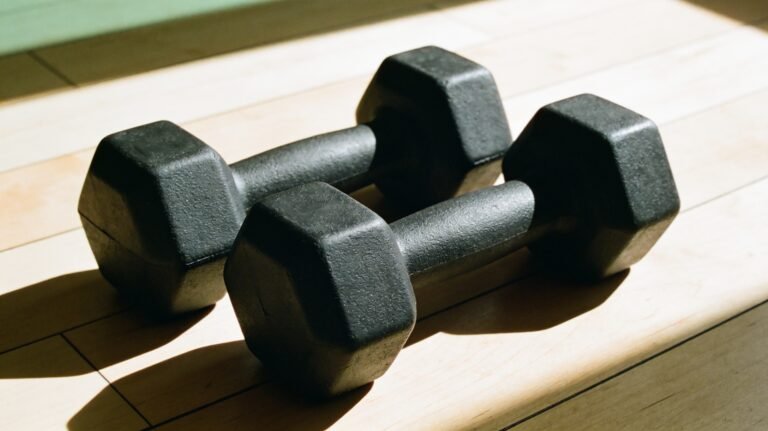
- A pair of adjustable dumbbells or two fixed weights (10lb and 15lb to start) – opens up dozens of exercises
- A pull-up bar for a doorframe – once you’re ready to progress pulling strength seriously
You do not need a full home gym to get strong. These three items cover 90% of what a beginner needs for the first year.
How This Connects to Your Other Fitness Goals
Strength training doesn’t have to replace everything else you’re doing. It works well alongside cardio, walking, and yoga. If you’re also working on home cardio for weight loss, pair it with 2-3 strength sessions per week rather than replacing one with the other.
If you’re brand new to working out entirely, check out our complete guide for people who have never exercised before starting this program. And once you’ve got a solid base, our dumbbell-only strength program is a natural next step.
Recovery matters too. If you’re pushing yourself three days a week, make sure you’re getting enough sleep and eating enough protein. Our high-protein foods list is a good reference for knowing what to eat to support the work you’re putting in.
A Note on Comparing Yourself to Others Online
The before-and-after photos on fitness accounts are almost always taken under optimal lighting, after months of work, and sometimes after very aggressive cuts. They are not what eight weeks of beginner training looks like for most people.
What eight weeks of consistent strength training actually produces: better posture, noticeably more energy, a sense of capability you didn’t have before, and the start of real physical changes. That’s not nothing. That’s actually a lot.
The women who get real results from home strength training are the ones who stop looking for a perfect program and just start the imperfect one in front of them.
Frequently Asked Questions
How many days a week should a beginner woman do strength training at home?
Three days per week with at least one rest day between sessions is the sweet spot for beginners. It gives your muscles enough stimulus to adapt and enough time to recover. Going every day as a beginner increases injury risk and actually slows progress because your muscles don’t have time to rebuild.
How long before I see results from strength training at home?
You’ll feel stronger within 2-3 weeks as your nervous system adapts. Visible physical changes typically appear around weeks 6-8 with consistent training and adequate protein intake. Factors like sleep, stress, and diet all affect the timeline.
Can I build real muscle with just bodyweight exercises?
Yes, especially as a beginner. Bodyweight training provides enough resistance to build foundational strength and muscle. After 4-6 weeks, you’ll likely need to add resistance bands or light dumbbells to keep progressing, since your bodyweight becomes less challenging as you get stronger.
What should I eat on strength training days?
Prioritize protein (aim for 0.7-1g per pound of bodyweight), eat enough calories to support your activity level, and time a small protein-rich snack within 1-2 hours after your workout. You don’t need to eat drastically different on training days, but skipping meals will slow recovery.
Is it okay to do strength training and cardio in the same week?
Absolutely. Most fitness professionals recommend combining both. Do strength training on 3 days and cardio (walking, cycling, jogging) on 2-3 other days. Avoid doing intense cardio immediately before a strength session if you want to perform your best in the weights.
Will I get bulky from strength training at home?
No. Women have significantly lower testosterone levels than men, which limits how much muscle mass you can build without intentional effort to do so. What you’ll get is more definition, strength, and a leaner physique, not bulk.
Building strength at home takes consistency more than it takes anything else. Three sessions a week, the movements in this guide, and a bit of patience. That’s the whole plan. Build the habit first and the results will follow.
Save this guide for your next session, or share it with someone who keeps saying they’ll start next Monday.