How to Start Working Out When You Have Never Exercised (Complete Beginner Guide)
By Jake Reynolds | Certified Personal Trainer | Last updated: May 2, 2026 | 11 min read
Save this beginner workout guide to your Fitness board on Pinterest — your first step to a fitter life starts here!
Starting from zero is harder than starting over. When you have never exercised regularly, you do not just need a workout — you need a complete framework that tells you what to do, when to do it, how hard to push, and what to expect in the first few weeks.
Most beginner guides fail because they skip the psychology. They give you a plan but not the mindset. And 80% of beginners quit within the first month — not because they were incapable, but because no one told them what “normal” looks like when you are just starting out.
This guide covers everything. If you are wondering how to start working out as a complete beginner, you are in the right place. By the end, you will have a plan, realistic expectations, and a clear first week mapped out.
A quick note from Jake
I have coached hundreds of complete beginners over the years. The ones who succeed long-term are almost never the most motivated on day one. They are the ones who start small, build slowly, and treat consistency as the goal — not intensity. The first four weeks are entirely about building the habit. The physical results come after that.
Quick Answer: How to Start Working Out as a Complete Beginner
- Start with 2 to 3 sessions per week, 15 to 20 minutes each
- Focus on basic compound movements — squats, push-ups, plank, walking
- Prioritise form over speed or weight
- Build by 10% per week — add one rep, one set, or one extra minute
- Track your sessions and celebrate showing up, not just results
Table of Contents
- The Mindset Shift You Need First
- Your First Week Plan
- The Best Beginner Exercises
- How Often Should Beginners Work Out?
- How to Progress Without Overtraining
- 5 Mistakes That Kill Beginner Progress
- Frequently Asked Questions
The Mindset Shift You Need Before Starting
The biggest reason beginners quit has nothing to do with fitness — it is about expectations.
Week one will feel uncomfortable. Your muscles will be sore. You will feel uncoordinated and out of breath doing things that look effortless online. This is completely normal and has nothing to do with your potential.
Reframe your goal for the first four weeks. Do not train to lose weight, build muscle, or transform your body yet. Train to become someone who exercises consistently. Once that identity is established, everything else follows.
Your First Week Plan
Week one is about showing up — not about how hard you push.
| Day | Activity | Duration |
|---|---|---|
| Monday | Beginner bodyweight circuit | 20 min |
| Tuesday | Rest or 20-min walk | 20 min |
| Wednesday | Beginner bodyweight circuit | 20 min |
| Thursday | Rest or light stretching | 15 min |
| Friday | Beginner bodyweight circuit | 20 min |
| Saturday | Rest or walk | Any |
| Sunday | Full rest | – |
The Best Beginner Exercises to Start With
1. Bodyweight Squats
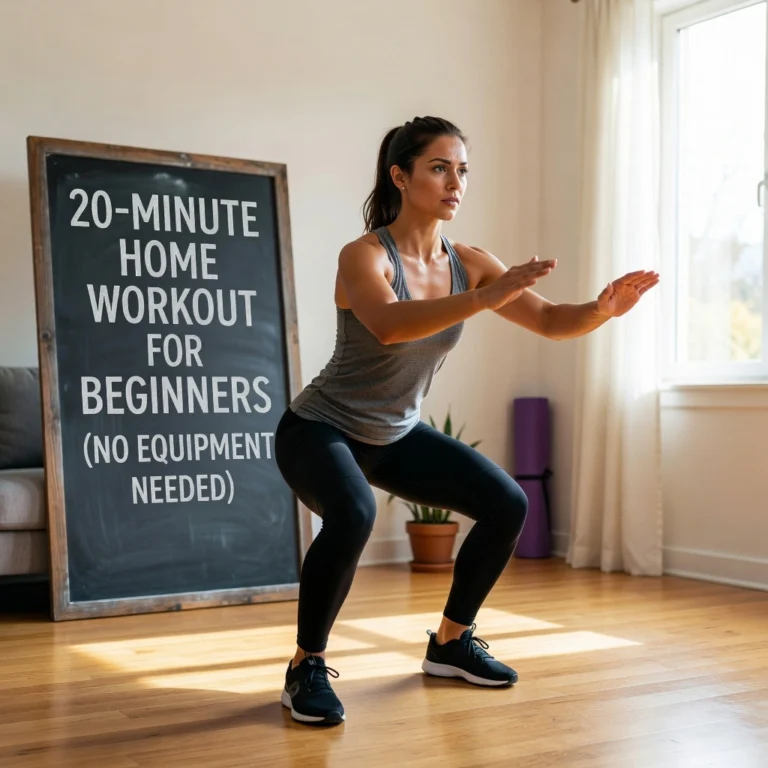
The single most important movement pattern for beginners — it trains your legs, glutes, and core simultaneously. Stand with feet shoulder-width apart, push your hips back, and lower until thighs are parallel to the floor. Drive through your heels to stand. Start with 3 sets of 8 and build from there.
2. Knee Push-Ups
A full push-up is a bodyweight bench press — knee push-ups are the perfect starting point. Lower your body to the floor with control, keeping your body in a straight line from knees to shoulders. Push back up. Once you can do 15 with good form, progress to full push-ups.
3. Glute Bridges
Essential for activating the glutes, which most sedentary people have largely switched off. Lie on your back, knees bent. Drive your hips to the ceiling by squeezing your glutes, hold for one second, and lower slowly. Start with 3 sets of 10.
4. Plank (Modified)
The best core exercise for beginners — it strengthens everything without loading your spine. Start on your knees and forearms if a full plank is too difficult. Keep your body in a straight line from head to knees. Hold for 15 to 20 seconds and build from there.
5. Walking
Wildly underestimated as a fitness tool — walking 7,000 to 10,000 steps daily burns significant calories and builds cardiovascular base. On your rest days, a 20 to 30-minute walk is the perfect active recovery that accelerates your overall progress without adding training stress.
Once home training starts to feel easy, moving to a gym gives you the loading options bodyweight cannot. Our beginner gym workout plan lays out the first four weeks session by session.
How Often Should Beginners Work Out?
Three sessions per week is the evidence-based sweet spot for complete beginners.
More than that and you risk overtraining, excessive soreness, and burnout. Less than that and the habit never solidifies. Three sessions hit the minimum effective dose for progress while leaving enough recovery time for your muscles to adapt.
After four to six weeks of consistent three-sessions-per-week training, you can add a fourth session if you want to increase the training volume.
How to Progress Without Overtraining
The 10% rule: never increase total weekly training volume by more than 10% in a single week.
If you did 3 sets of 8 squats this week (24 total reps), next week you can go to 3 sets of 9 (27 total reps). Small, steady increases are how you build strength safely over months without injury or burnout.
Signs you are progressing at the right pace: exercises feel moderately challenging but not impossible, you recover well between sessions, and your mood and energy improve week on week.
Signs you are overdoing it: you feel consistently exhausted, your mood drops, you dread sessions, and your performance is declining rather than improving. If these appear, take an extra rest day and reduce intensity by 20%.
5 Mistakes That Kill Beginner Progress
- Starting too hard. Going full intensity in week one almost always leads to excessive soreness, missed sessions, and quitting by week two. Start at 60% of what you think you can do.
- Comparing to more advanced people online. What you see on social media is not a beginner plan. Most fitness content is made by people who have been training for years. Their “easy” workout is your advanced workout.
- Changing the plan too soon. Beginners often switch programs after two weeks because they are not seeing results yet. Results take six to eight weeks. Stay with one program long enough to actually let it work.
- Skipping the warm-up and cool-down. Injury is the number one thing that stops beginner progress. A three-minute warm-up and two-minute cool-down stretch eliminates most of the risk.
- Ignoring sleep. Your body builds muscle and burns fat during sleep, not during the workout. Seven to nine hours of sleep per night is a non-negotiable part of any fitness plan.
Frequently Asked Questions
How do I start working out when I am completely out of shape?
Start with two to three short sessions per week of 15 to 20 minutes. Focus on basic movements — walking, bodyweight squats, and push-ups. Consistency matters far more than intensity in the first four to six weeks.
What is the best workout for a complete beginner?
For complete beginners, a simple bodyweight circuit (squats, push-ups, glute bridges, plank) done three times per week is ideal. It builds foundational strength, requires no equipment, and is easy to progress.
How long does it take to see results from working out?
Most beginners notice improved energy and mood within two weeks. Visible physical changes — muscle definition and fat loss — typically take six to eight weeks of consistent training and proper nutrition.
Should I do cardio or weights as a beginner?
Both are beneficial, but for beginners, combining them in a simple circuit workout is most time-efficient. If you had to choose one, resistance training preserves more muscle and elevates metabolism longer than cardio alone.
Is it okay to work out every day as a beginner?
No — not with the same exercises daily. Beginners need rest days for muscle recovery and adaptation. Three to four sessions per week with rest days between is the evidence-based starting point.
What should I eat before my first workout?
A light meal with carbohydrates and protein about 60 to 90 minutes before works well. A banana and Greek yoghurt, or toast with peanut butter, gives you energy without feeling heavy during exercise.
Final Thoughts
Learning how to start working out is less about the perfect plan and more about starting imperfect and staying consistent. The workout matters far less than the habit you build around it.
Pick three days this week. Do 20 minutes of the beginner circuit above. Do not worry about speed, weight, or results yet. Just show up. Do that for four weeks and you will not recognise where you started.
For your next steps, check out our guides on the complete 20-minute beginner home workout, how to build a workout habit that sticks, and what to eat before and after a workout.
Found this guide helpful? Pin it to your Fitness board so you can come back to it whenever you need a reminder!
Jake Reynolds
Certified Personal Trainer and Nutrition Coach
Jake Reynolds is a certified personal trainer and nutrition coach with over 10 years of experience helping people build sustainable fitness habits. He specialises in home workouts, fat loss strategies, and evidence-based nutrition advice that fits real life.
Disclosure: This post may contain affiliate links. If you purchase through these links, we may earn a small commission at no extra cost to you. We only recommend products we genuinely use and trust.
nn