20-Minute Home Workout for Beginners (No Equipment Needed)
By Jake Reynolds | Certified Personal Trainer | Last updated: May 2, 2026 | 9 min read
Save this 20-minute beginner workout to your Fitness board on Pinterest. You will want it on your first workout morning!
You do not need a gym, equipment, or an hour of free time to get fit. A 20-minute home workout for beginners is genuinely enough to build strength, improve your cardiovascular fitness, and start losing body fat — if you do it consistently.
The problem most beginners face is not motivation. It is not equipment. It is having a clear, structured plan that tells them exactly what to do and in what order. Without that, you waste five minutes thinking, do a few random exercises, and call it a day.
This guide gives you that plan. A complete 20-minute beginner workout you can do in your living room, starting today, with zero equipment and zero experience required.
A quick note from Jake
When I started training clients, the ones who made the fastest progress were not the ones with the best equipment. They were the ones who showed up consistently for short sessions. Twenty minutes, four times a week, beats a two-hour session once a fortnight every single time. Start small. Stay consistent. The rest follows.
Quick Answer: How to Do a 20-Minute Beginner Home Workout
- Warm up for 3 minutes (marching, arm circles, hip rotations)
- Do 3 rounds of 5 bodyweight exercises (40 seconds on, 20 seconds rest)
- Rest 60 seconds between rounds
- Finish with 2 minutes of cool-down stretching
- Aim for 3 to 4 sessions per week
Table of Contents
- Why 20 Minutes Is Enough
- The 3-Minute Warm-Up
- The 20-Minute Beginner Workout
- Exercise-by-Exercise Breakdown
- How to Progress Week by Week
- Common Beginner Mistakes
- Frequently Asked Questions
Why 20 Minutes Is Genuinely Enough for Beginners
There is a persistent belief that workouts need to be long to be effective. It is wrong — especially for beginners.
When you are new to exercise, your body responds to almost any training stimulus. You do not need two hours of gym time to trigger muscle growth, cardiovascular improvement, or fat loss. A focused 20-minute session, done properly, creates enough physiological stress to produce real results.
The real advantage of short workouts for beginners is adherence. Research consistently shows that people who start with shorter, achievable sessions build the exercise habit faster and maintain it longer. You are far more likely to do 20 minutes every day than an hour three times a week.
The 3-Minute Warm-Up (Never Skip This)
A proper warm-up is not optional — it prepares your joints, muscles, and heart for the work ahead.
Do each movement for 30 seconds, back to back:
- March in place — lift your knees high, swing your arms
- Arm circles — small to large, forward then backward
- Hip circles — hands on hips, rotate slowly in both directions
- Leg swings — hold a wall, swing each leg forward and back 10 times
- Torso rotations — arms out, rotate your upper body side to side
- Jumping jacks (slow) — easy pace to raise heart rate gently
The 20-Minute Beginner Home Workout
Format: 3 rounds of 5 exercises. Each exercise: 40 seconds work, 20 seconds rest. Rest 60 seconds between rounds.
| Exercise | Work | Rest | Targets |
|---|---|---|---|
| Bodyweight Squats | 40 sec | 20 sec | Legs, glutes |
| Push-Ups (or Knee Push-Ups) | 40 sec | 20 sec | Chest, arms, core |
| Glute Bridges | 40 sec | 20 sec | Glutes, hamstrings |
| Standing Mountain Climbers | 40 sec | 20 sec | Core, cardio |
| Plank Hold | 40 sec | 20 sec | Core, shoulders |
Total workout time: approximately 20 minutes including warm-up and cool-down.
Exercise-by-Exercise Breakdown
1. Bodyweight Squats
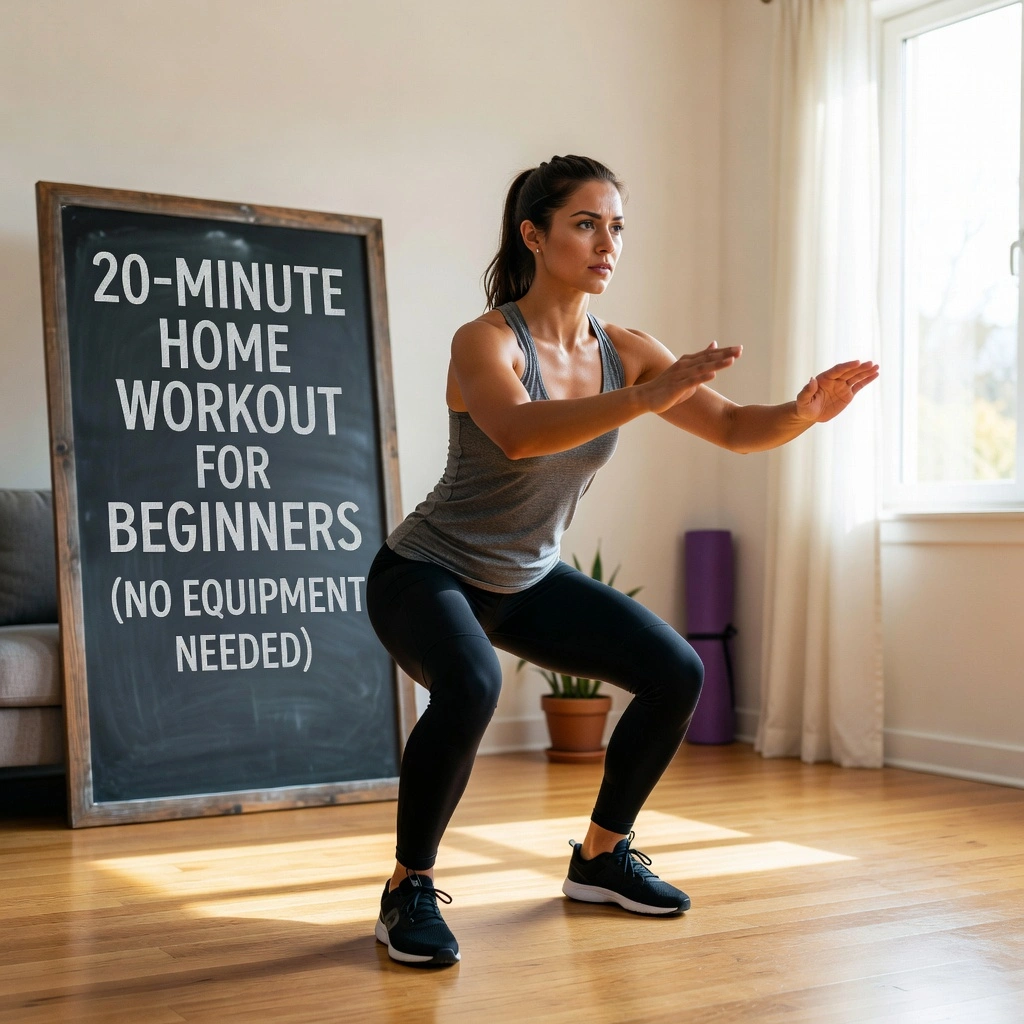
The foundational lower body movement every beginner needs to master. Stand with feet shoulder-width apart. Push your hips back and bend your knees until your thighs are parallel to the floor (or as low as comfortable). Drive through your heels to stand. Keep your chest up throughout.
Beginner modification: Use a chair behind you as a target — lower until you barely touch it, then stand.
2. Push-Ups (or Knee Push-Ups)
The best upper body exercise you can do without any equipment. Place hands slightly wider than shoulders, body in a straight line from head to heels. Lower your chest to the floor, then push back up. If full push-ups are too hard, drop to your knees — the movement is identical, just easier.
Goal: Work toward full push-ups by week 4.
3. Glute Bridges
Critical for activating your glutes, which most beginners have completely switched off from sitting all day. Lie on your back, knees bent, feet flat on the floor. Drive your hips toward the ceiling by squeezing your glutes hard. Hold for one second at the top, then lower slowly.
4. Standing Mountain Climbers
A joint-friendly cardio movement that gets your heart rate up without impact. Stand facing a wall. Place your hands on the wall at chest height. Drive your knees up to your chest alternately, like running on the spot. Increase speed to increase intensity.
No-impact alternative to floor mountain climbers — perfect if you have knee or wrist issues.
5. Plank Hold
The single best core exercise for beginners — it works everything at once. Start in a push-up position, then lower onto your forearms. Keep your body in a straight line from head to heels. Do not let your hips sag or rise. Breathe steadily throughout.
Beginner target: Hold for 20 seconds in week 1, building to 40 seconds by week 4.
How to Progress Week by Week
Your body adapts quickly — you need to keep making the workout slightly harder every week.
| Week | Adjustment |
|---|---|
| Week 1 | 2 rounds, 30 sec work / 30 sec rest, focus on form |
| Week 2 | 3 rounds, 40 sec work / 20 sec rest |
| Week 3 | 3 rounds, 45 sec work / 15 sec rest, reduce round rest to 45 sec |
| Week 4 | 4 rounds, 45 sec work / 15 sec rest, progress to harder variations |
5 Common Beginner Mistakes to Avoid
- Skipping the warm-up. Cold muscles and joints are injury-prone. Three minutes of warm-up is non-negotiable.
- Going too fast. Speed is the enemy of good form, especially for squats and push-ups. Slow, controlled reps build more strength than sloppy fast ones.
- Working out every single day. Rest days are when your muscles actually grow. Three to four sessions per week is the sweet spot for beginners.
- Giving up after two weeks. The first two weeks are the hardest. Your body is adapting and you will feel sore and tired. Push through to week three and it gets dramatically easier.
- Ignoring nutrition. Exercise alone will not transform your body. A high-protein diet with a moderate calorie deficit works alongside training to produce real results.
Ready to add weight to these movements? Our beginner gym workout is the natural next step once bodyweight sets stop being challenging.
Frequently Asked Questions
Is 20 minutes of exercise a day enough for beginners?
Yes. For beginners, 20 minutes of consistent exercise is highly effective. Research shows short, structured sessions build the habit faster than long workouts, and habit is the hardest part to crack when you are just starting out.
Can I lose weight with a 20-minute home workout?
Absolutely. Weight loss depends primarily on diet, but 20-minute workouts boost calorie burn, build metabolic muscle, and support fat loss when combined with a moderate calorie deficit.
How many times a week should a beginner work out at home?
Three to four times per week is ideal for beginners. This allows enough stimulus for progress while giving your body adequate recovery time between sessions.
Do I need to warm up before a 20-minute workout?
Yes, always warm up for 3 to 5 minutes before exercising. A proper warm-up raises your heart rate gradually, increases blood flow to muscles, and significantly reduces injury risk.
What is the best order of exercises in a beginner workout?
Start with a warm-up, then do compound movements like squats and push-ups first while your energy is highest. Finish with core work and a cool-down stretch.
Will I get sore after my first workout?
Probably yes. Delayed onset muscle soreness (DOMS) typically peaks 24 to 48 hours after your first session. It is normal, not dangerous, and gets much less severe after the first two weeks.
Final Thoughts
A 20-minute home workout for beginners is not a compromise. It is the smartest way to start. Short enough to actually do, structured enough to get results, and progressive enough to keep improving for months.
Do this workout three to four times this week. Focus on form over speed. Add one rep or one second to each exercise next week. That is all you need to do to build real fitness from scratch.
For more beginner-friendly fitness content, check out our guides on bodyweight workouts for complete beginners, how to build a workout habit that sticks, and what to eat before and after a workout.
Found this workout helpful? Save it to your Fitness board on Pinterest so you always have it on hand!
Jake Reynolds
Certified Personal Trainer and Nutrition Coach
Jake Reynolds is a certified personal trainer and nutrition coach with over 10 years of experience helping people build sustainable fitness habits. He specialises in home workouts, fat loss strategies, and evidence-based nutrition advice that fits real life.
Disclosure: This post may contain affiliate links. If you purchase through these links, we may earn a small commission at no extra cost to you. We only recommend products we genuinely use and trust.