Why You’re Not Losing Weight Eating Healthy (15 Real Reasons and the Fixes)
Save this article to your Weight Loss board on Pinterest. Finally, some honest answers about why the scale is not moving!
If you are eating healthy but not losing weight, you are not broken and you are not doing everything wrong. This is one of the most common and most frustrating experiences in the world of weight management. The problem is almost always specific and fixable — once you identify it.
Eating healthy and eating in a way that creates a calorie deficit are two different things. You can fill your diet entirely with organic vegetables, lean proteins, whole grains, and healthy fats, and still consume more energy than your body burns. Food quality is important, but it does not override the energy balance equation.
This article identifies the 15 most common real reasons people eat well but do not lose weight. More importantly, each one comes with a concrete fix. No fad advice, no elimination diets, no guilt — just clear explanations of what is happening in your body and what to do about it.
Quick Answer: Why You Are Not Losing Weight Eating Healthy (Top 5 Reasons)
- Portion sizes are larger than you think — even healthy foods are calorie-dense and easy to over-eat.
- Liquid calories are invisible — coffee drinks, juice, smoothies, and alcohol add up fast.
- You are overestimating your calorie burn — fitness trackers and gym machines often overstate calorie expenditure by 20-40%.
- Sleep deprivation is raising your hunger hormones — poor sleep increases ghrelin and decreases leptin, making you eat more.
- Your calorie target has not been adjusted for weight lost — as you lose weight, your maintenance calories drop too.
Table of Contents
Why Eating Healthy Alone Rarely Produces Weight Loss
Food quality and energy balance are two separate variables. Eating nutritious food improves your health markers, reduces inflammation, provides micronutrients, and makes you feel better. But it does not automatically create a calorie deficit, and only a calorie deficit consistently causes fat loss.
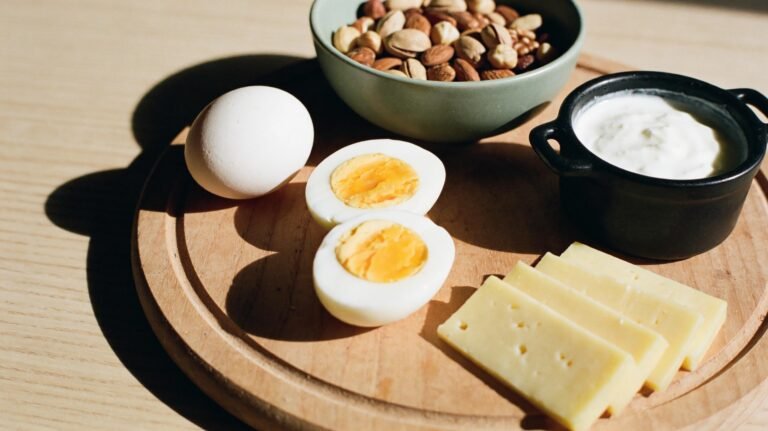
Whole, nutritious foods are often calorie-dense. A handful of almonds (1 oz, roughly 23 almonds) contains 160 calories. A tablespoon of olive oil contains 120 calories. An avocado contains 230 calories. These are excellent foods. But three portions of each across a day adds 510 calories before you have eaten a single meal.
This is not a reason to avoid these foods. It is a reason to understand that eating well and eating for fat loss require different levels of awareness. You need both quality and appropriate quantity to move the scale consistently.
15 Real Reasons You Are Not Losing Weight Eating Healthy
1. You are underestimating portion sizes — this is the most common reason, and it affects almost everyone who does not weigh food.
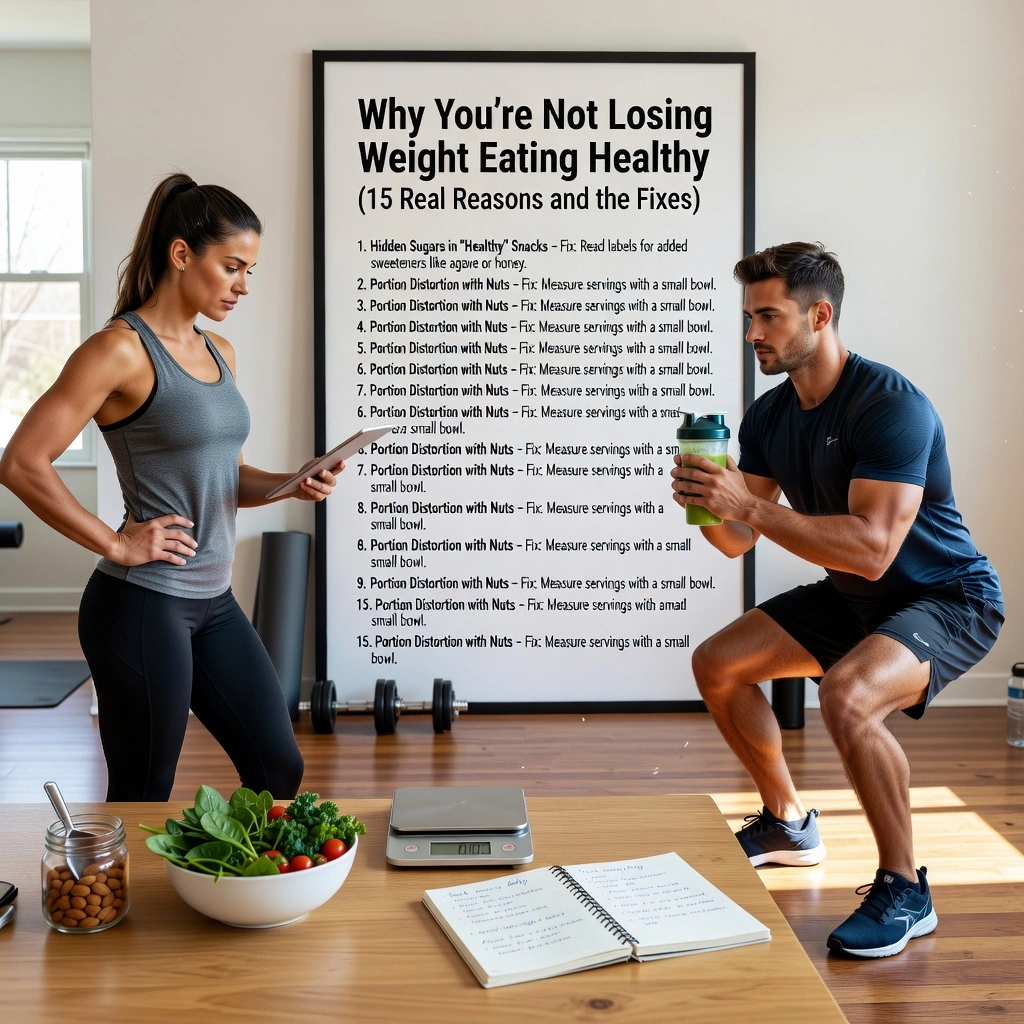
Research consistently shows that people underestimate their calorie intake by 20-50%. Visual estimation is unreliable. A “tablespoon” of peanut butter, poured freely, is often 2-3 tablespoons. A “handful” of granola is often 3 servings. Weighing food on a kitchen scale for 2-4 weeks is the most accurate, lowest-effort way to reveal these gaps. A basic kitchen scale costs $10-15.
2. Liquid calories are your biggest blind spot.
A large Starbucks vanilla latte contains 250 calories. A glass of orange juice is 110 calories. A smoothie from a juice bar typically runs 400-600 calories. A glass of wine is 125 calories. People often drink several of these daily and categorise them as “healthy” while tracking none of them. Switching to black coffee, sparkling water, and whole fruit immediately eliminates 300-600 liquid calories for many people.
3. You are overestimating how many calories you burn exercising.
A 45-minute moderate gym session burns roughly 250-350 calories for most people. Many fitness apps and treadmill displays show figures 30-40% higher. This leads people to “eat back” calories they did not actually burn. Exercise is essential for health and body composition, but for weight loss, nutrition creates the deficit — exercise maintains and enhances it.
4. Your calorie target has not been updated as you have lost weight.
Your total daily energy expenditure (TDEE) drops as your bodyweight decreases. A 180 lb person burns more calories at rest than the same person at 165 lb. If you set a calorie target when you started and never updated it, you may now be eating at maintenance or above without realising it. Recalculate your TDEE every 10-15 lb of weight lost.
5. Poor sleep is actively driving you to eat more.
Under 7 hours of sleep per night raises ghrelin (the hunger hormone) by roughly 15-20% and lowers leptin (the satiety hormone). Research shows sleep-deprived people consume an average of 300-500 extra calories per day compared to well-rested individuals. Even perfect nutrition choices are harder to maintain when your hunger regulation is chemically disrupted by poor sleep.
6. You are eating too little, which has slowed your metabolism.
When you eat far below your calorie needs for extended periods, your body adapts by reducing your metabolic rate — a process called adaptive thermogenesis. This is why very low-calorie diets often produce fast initial losses that then stall completely. A moderate deficit of 300-500 calories below your TDEE is more effective long-term than severe restriction.
7. Stress is chronically elevating cortisol, which promotes fat storage.
Cortisol, the primary stress hormone, increases appetite, promotes abdominal fat storage, and triggers cravings for sweet and salty foods. It also impairs sleep quality, which compounds the problem. If your life stress is high, your body is running biochemistry that works against weight loss. Managing stress is not a soft skill — it is a metabolic intervention.
8. Healthy snacks are adding more calories than your main meals.
Nuts, trail mix, protein bars, dried fruit, nut butters, and whole grain crackers are marketed as healthy snacks but are among the most calorie-dense foods available. It is genuinely easy to eat 600-800 calories in snacks in a day while tracking none of it. List every snack you eat in a day, look up the calories, and see what surprises you.
9. You have an undiagnosed hormonal condition limiting weight loss.
Hypothyroidism slows metabolism significantly. Insulin resistance (often preceding Type 2 diabetes) makes fat loss harder. Polycystic ovary syndrome (PCOS) in women is closely linked to weight gain and difficulty losing weight. If you have tracked accurately in a clear deficit for 4-6 weeks with minimal progress, ask your doctor to check TSH (thyroid), fasting insulin, and glucose levels.
10. Alcohol is providing more calories than you account for.
Alcohol contains 7 calories per gram — more than carbohydrates (4 cal/g) and protein (4 cal/g). A standard glass of wine is 125 calories. A pint of beer is 180-250 calories. Two gin and tonics is 200+ calories. Alcohol also lowers inhibitions around food choices and reduces sleep quality. Many people find that removing or significantly reducing alcohol alone breaks a plateau.
11. Weekend eating is undoing weekday progress.
Many people eat in a moderate deficit Monday through Friday and significantly over-eat on Saturday and Sunday. Research shows this is one of the most common patterns in people who are not losing weight despite “eating well.” A 500-calorie daily deficit produces 3,500 calories of deficit per week. Two days of 1,000-calorie surpluses completely erases it.
12. You are building muscle at the same rate you are losing fat — the scale does not reflect this.
If you have recently started resistance training alongside a new diet, it is entirely possible to lose fat and gain muscle simultaneously. The scale may not move, but your body composition is improving. Take monthly progress photos and body measurements in addition to weighing yourself. Waist, hip, and thigh measurements often show change when the scale does not.
13. [REPLACE WITH A REAL PHOTO] — Your food journal or tracking setup.
[REPLACE WITH A REAL PHOTO — photograph your food tracking app, journal, or weekly meal plan. Caption: “What my tracking setup actually looks like on a normal week. Jake Reynolds, healthfitness-blog.com”]
[REPLACE — describe your personal experience with food tracking. What surprised you? What did you discover was over-estimated? Personal data and real stories are the strongest trust signal you can add to this section.]
14. You are eating too infrequently, which drives overeating at meals.
Skipping breakfast or going 6-8 hours without eating often leads to being ravenously hungry by the next meal. Hunger of that magnitude overrides rational food choices and portion control. Eating 3-4 moderate meals spread through the day keeps hunger more stable and makes calorie control significantly easier than two large meals.
15. Your definition of “healthy” includes too many processed foods marketed as healthy.
Protein bars, gluten-free snacks, low-fat yoghurt, veggie chips, and granola are frequently perceived as diet foods but are often high in sugar and calories. A Clif Bar contains 260 calories and 45 g of carbohydrates. Low-fat flavoured yoghurt often contains as much sugar as a dessert. Read the nutrition label, not the front-of-pack marketing claims.
Calorie Deficit Calculator
Find your maintenance calories and recommended weight loss target.
Calorie Density: “Healthy” Foods That Surprise People
| Food | Serving | Calories | Common Mistake |
|---|---|---|---|
| Almonds | 1 oz (23 nuts) | 160 cal | Eating 2-3 oz without measuring |
| Avocado | 1 whole | 230 cal | Adding to every meal |
| Olive oil | 1 tbsp | 120 cal | Free-pouring into the pan |
| Granola | 1/2 cup | 200-300 cal | Using as a full bowl topping |
| Peanut butter | 2 tbsp | 190 cal | Spreading generously x2-3 times |
| Brown rice | 1 cup cooked | 215 cal | Serving 2 cups as a “portion” |
| Orange juice | 8 oz glass | 110 cal | Drinking 16 oz with breakfast |
| Clif Bar | 1 bar (68 g) | 260 cal | Eating as a “light snack” |
5 Weight Loss Mistakes to Avoid
- Treating “healthy” and “low calorie” as the same thing. They are not. Many nutritious foods are calorie-dense. You can improve your health with a nutritious diet and still gain weight if total calories exceed your expenditure.
- Weighing yourself every day and reacting to daily fluctuations. Body weight fluctuates 1-5 lb daily based on water retention, sodium, hormones, and bowel movements. Daily weigh-ins cause anxiety. Weigh weekly at the same time and look at the 4-week trend, not single readings.
- Going all-or-nothing after one bad day. One day of over-eating adds at most 1,000-2,000 extra calories. That does not undo weeks of progress. What undoes progress is quitting entirely after the bad day and not returning for two weeks.
- Doing only cardio and skipping strength training. Cardio burns calories during exercise. Strength training builds muscle, which raises your resting metabolic rate. Including 2-3 strength sessions per week means you burn more calories every hour of every day, not just during workouts.
- Setting a timeline that is too aggressive. Expecting to lose 2+ lb per week on a healthy diet is unrealistic for most people and leads to frustration when it does not happen. A realistic, sustainable rate is 0.5-1 lb per week. That is 26-52 lb in a year — genuinely significant progress.
Frequently Asked Questions
Can you eat too little and not lose weight?
Yes. Eating too little for too long can suppress your metabolic rate through adaptive thermogenesis. Your body reduces energy expenditure to match the reduced intake. A moderate calorie deficit of 300-500 calories per day is more sustainable and produces better long-term outcomes than severe restriction.
Why am I not losing weight when I exercise and eat healthy?
The most common reasons include underestimating portion sizes, overestimating calorie burn from exercise, not accounting for liquid calories, poor sleep elevating hunger hormones, and eating in a caloric surplus even on whole foods. Tracking accurately for one week often reveals the gap.
Does stress cause weight gain even when eating healthy?
Yes. Chronic stress elevates cortisol, which increases appetite, promotes fat storage around the abdomen, and triggers cravings for high-calorie foods. High cortisol also impairs sleep, which further raises ghrelin. Managing stress is a genuine weight loss lever, not just a wellness platitude.
How long does a weight loss plateau last?
Most weight loss plateaus last 2-6 weeks if you make adjustments. Common adjustments: recalculate your calorie target, increase protein to 1 g per lb of bodyweight, add a weekly diet break at maintenance calories, or introduce a new form of exercise to create a fresh metabolic stimulus.
Can hormones prevent weight loss?
Yes. Hypothyroidism, PCOS, insulin resistance, and chronically elevated cortisol can all make weight loss significantly harder. If you have tracked accurately for 4-6 weeks in a clear calorie deficit without losing weight, ask your doctor to check thyroid function and fasting insulin levels.
Is it possible to gain weight on a healthy diet?
Yes. Healthy foods like avocado, nuts, olive oil, whole grains, and fruit are nutritious but calorie-dense. Eating them in large portions creates a caloric surplus, and any surplus leads to weight gain regardless of food quality. Nutrition quality and calorie balance are two separate variables.
Final Thoughts
If you are eating well but not losing weight, the answer is almost always findable. Start by tracking your food accurately for one week — not to judge yourself but to gather data. Most people find the answer within the first three days of honest tracking.
Address the low-hanging fruit first: liquid calories, portion sizes, sleep quality. These three changes alone have broken many people’s plateaus without requiring any change to the actual foods they eat. Then use the calorie calculator above to confirm you are actually eating below your maintenance level.
You are not broken. You are working with incomplete information. This article gives you the full picture. Use it.
For more support, read our guides on how to track calories without obsessing over food, the best high protein meals for fat loss, and how sleep affects your body composition.
Finally understand why the scale is not moving? Save this to Pinterest so you can share it with someone who needs it!
Transparency notice: This post may contain affiliate links. If you purchase through a link on this page, we may earn a small commission at no extra cost to you. All calorie and nutrition figures are approximate. This content is for informational purposes only and is not a substitute for personalised advice from a registered dietitian or medical professional.