Skipping leg day is easy when you do not know what to do once you get there. This beginner leg day workout routine gives you a clear plan for the gym and for your living room, with simple exercises, sensible sets and reps, and a four-week progression. No fancy equipment is required, and every move has an easier option.
Why Leg Day Is Worth Doing
Your legs hold some of the largest muscles in your body, including the quadriceps, hamstrings, and glutes. Training them helps you climb stairs, carry groceries, and get up from a chair with less effort. Strong legs also support your hips, knees, and back in everyday movement.
Because big muscles work hard, leg sessions can also feel demanding, which is why beginners benefit from a gradual start. Results vary between people, so focus on how movements feel and on small improvements week to week rather than on a specific outcome.
Before You Start: Warm-Up and Safety
Spend five to ten minutes warming up. Walk briskly or march in place for two minutes, then add leg swings, hip circles, and ten bodyweight squats to a comfortable depth. The aim is to feel warm and loose, not tired.
- Choose weights you can lift for all reps with good form. The last two reps should feel challenging but controlled.
- Keep your knees tracking in line with your toes and your chest lifted during squats and lunges.
- Breathe steadily; do not hold your breath through the hard part of a rep.
- Stop if you feel sharp pain, dizziness, or joint pain, which is different from normal muscle effort.
If you have an injury, a heart or joint condition, or you are pregnant, talk to a doctor or physiotherapist before starting. For general activity advice, see the NHS physical activity guidelines.
The Gym Leg Day Routine
Do this workout once or twice a week with at least a day of rest in between. Rest about 60 to 90 seconds between sets. If you are brand new to the gym, our beginner gym workout guide shows how to fit leg day into a full week.
Goblet Squat: 3 sets of 8 to 12
Hold one dumbbell against your chest, feet shoulder-width apart. Sit your hips down and back, keep your chest tall, then stand by pressing through your whole foot. Use a box or bench behind you as a depth guide if you are unsure how low to go.
Leg Press: 3 sets of 10 to 12
Set your feet shoulder-width on the platform and lower the sled until your knees bend comfortably, without your lower back lifting off the pad. Press back up without locking your knees hard. It is a stable way to build leg strength while you learn squat form.
Dumbbell Romanian Deadlift: 3 sets of 8 to 10
Hold dumbbells in front of your thighs, slightly bend your knees, and push your hips back while keeping your back flat. Lower until you feel a stretch in your hamstrings, then squeeze your glutes to stand. Start light to learn the hip hinge.
Split Squat or Lunge: 2 sets of 8 per leg
Step one foot forward, lower your back knee toward the floor, and press through your front heel to rise. Hold a rail for balance if needed. Split squats, where your feet stay in place, are easier to control than walking lunges.
Standing Calf Raise: 2 sets of 12 to 15
Stand with the balls of your feet on a step or a flat floor, rise onto your toes, pause briefly, and lower slowly. Hold something stable for balance.
The At-Home Leg Day Routine
No gym membership? This version uses bodyweight, a chair, and optional water bottles or a backpack with books for extra load. Complete the circuit with 60 seconds of rest between rounds. For more no-equipment ideas, try our 20-minute home workout for beginners.
Chair Squat: 3 sets of 10 to 15
Stand in front of a sturdy chair, sit down with control until you lightly touch the seat, then stand up without using your hands if you can. Slow down the lowering phase to make it harder.
Glute Bridge: 3 sets of 12 to 15
Lie on your back with knees bent and feet flat. Press through your heels to lift your hips until your body forms a straight line from shoulders to knees, squeeze, then lower slowly.
Reverse Lunge: 2 sets of 8 per leg
Step one foot back and lower your knee toward the floor, then push through your front foot to return. Stepping backward is often kinder on the knees than stepping forward.
Wall Sit: 3 holds of 20 to 40 seconds
Slide down a wall until your thighs are roughly parallel to the floor, with knees above ankles. Hold, breathe, and stand up slowly.
Single or Double Calf Raise: 2 sets of 12 to 20
Rise onto your toes using a wall for balance. Progress to one leg at a time as it gets easier.
A Simple 4-Week Progression
Progress slowly so your body can adapt. Here is an easy way to build up, using either routine above.
- Week 1: Do 2 sets of each exercise with light effort and focus on form.
- Week 2: Move to 3 sets of the main exercises, keeping the same weights.
- Week 3: Add a small amount of weight, or slow each lowering phase to about three seconds.
- Week 4: Repeat week 3, or add a few reps per set if the work feels comfortable.
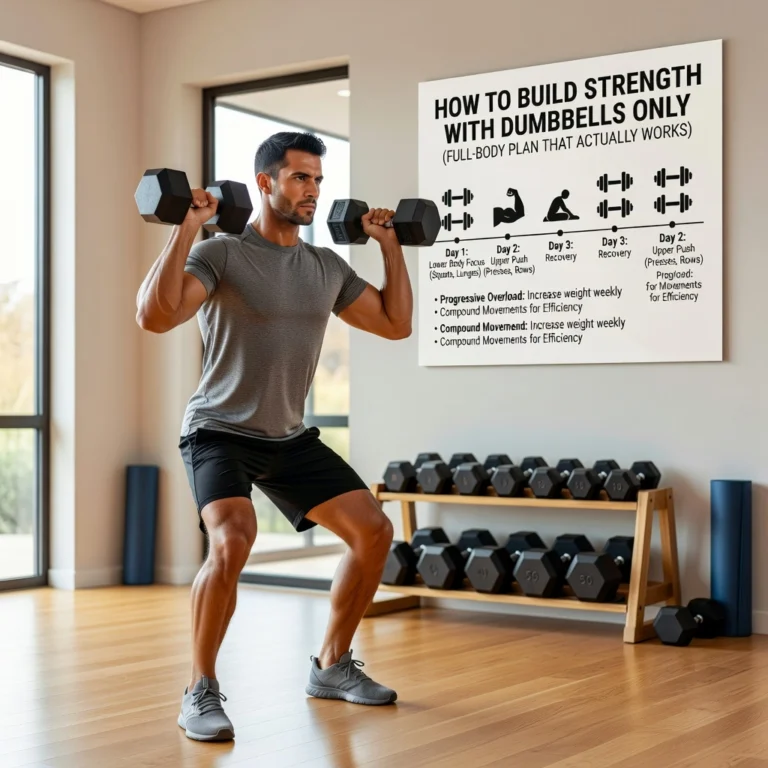
This idea is called progressive overload: gradually asking a little more of your muscles so they keep adapting. Write down your sets, reps, and weights so you can see improvement. Our guide to building strength with dumbbells only offers a wider plan once leg day feels familiar, and strength training for weight loss explains how lifting fits wider goals.
Recovery and Fuelling
Muscles adapt between sessions, not during them. Mild soreness for a day or two after a new leg workout is common; severe pain or soreness that lasts well beyond a few days is a sign to back off. Sleep, easy walking, and rest days all help. Read how to recover faster after a workout for practical tips.
Eating regular meals with enough protein, carbohydrates, and fluids supports training. We cover timing ideas in what to eat before and after a workout. If you follow a special diet or have a health condition, ask a registered dietitian or doctor for personal guidance.
A simple weekly layout could be leg day on Monday or Tuesday, an upper-body or full-body session on Thursday, and easy walks or stretching on the other days. Keep at least one full rest day each week. If a session feels too much, drop a set from each exercise rather than skipping the workout entirely, since showing up consistently matters more than any single hard day. Listen to your body, adjust as needed, and remember that every experienced lifter once started with light weights and a lot of questions.
Common Beginner Mistakes
- Going too heavy too soon: technique first, load second.
- Skipping the warm-up: cold muscles and joints are less ready for work.
- Letting knees cave inward: push your knees gently outward, in line with your toes.
- Cutting depth or speed corners: controlled reps beat rushed ones.
- Training legs every day: recovery time is part of the plan.
- Expecting fast results: consistent practice over weeks is what counts. If you need help getting started overall, see how to start working out as a complete beginner.
Frequently Asked Questions
How often should a beginner do leg day?
Once or twice a week is a sensible starting point for most beginners, with at least one rest day between leg sessions. This gives muscles time to recover and adapt. As your fitness improves, you can adjust based on how you feel and your wider schedule.
How many sets and reps should I do?
A common beginner range is 2 to 3 sets of 8 to 15 repetitions per exercise. Choose a weight or variation that makes the last couple of reps challenging while your form stays good. If form slips, reduce the load or reps.
Can I do leg day at home without equipment?
Yes. Bodyweight squats, glute bridges, lunges, wall sits, and calf raises can build a solid base. Slow the tempo, add pauses, or hold a backpack to make things harder over time. Equipment becomes more useful later, but it is not required to begin.
Why do my knees hurt during squats?
Common causes include stance, depth, or doing too much too soon. Try a box squat, lower the range of motion, and keep knees in line with toes. Sharp or persistent knee pain is a reason to stop and consult a physiotherapist or doctor.
Final Thoughts
A good beginner leg day workout routine is simple, repeatable, and gradually progressive. Pick the gym or home version, learn the movements, and add challenge slowly. For broader guidance on weekly activity, the American College of Sports Medicine offers helpful exercise guidelines. Check with a healthcare professional if you have any concerns before you begin.