Quick summary
A beginner gym workout is a short, full-body session built from a handful of basic movements, performed two or three times a week. You do not need a complicated split, a personal trainer, or more than about 45 minutes. This guide covers what to bring, how to pick your starting weight, a complete four-week plan with two alternating sessions, the gym etiquette nobody explains, and how to know when to add weight.
What a beginner gym workout actually looks like
Most people walking into a gym for the first time assume they need a different workout for every day of the week. They don’t. For your first few months, a full-body routine two to three times a week outperforms a body-part split, because each muscle group gets trained more often and you get more practice at each movement.
Every effective beginner session is built from the same small set of movement patterns: a squat, a hinge, a push, a pull, and something for your core. Pick one exercise per pattern, do three sets of each, and you have a complete workout. If you want to go deeper on the patterns themselves, our guide to functional strength training movement patterns breaks each one down.
The public health baseline is modest: the CDC recommends adults do muscle-strengthening activity on at least 2 days per week, working all major muscle groups. Three days gives you a productive margin above that without the recovery cost of training more often.
What to bring on your first day
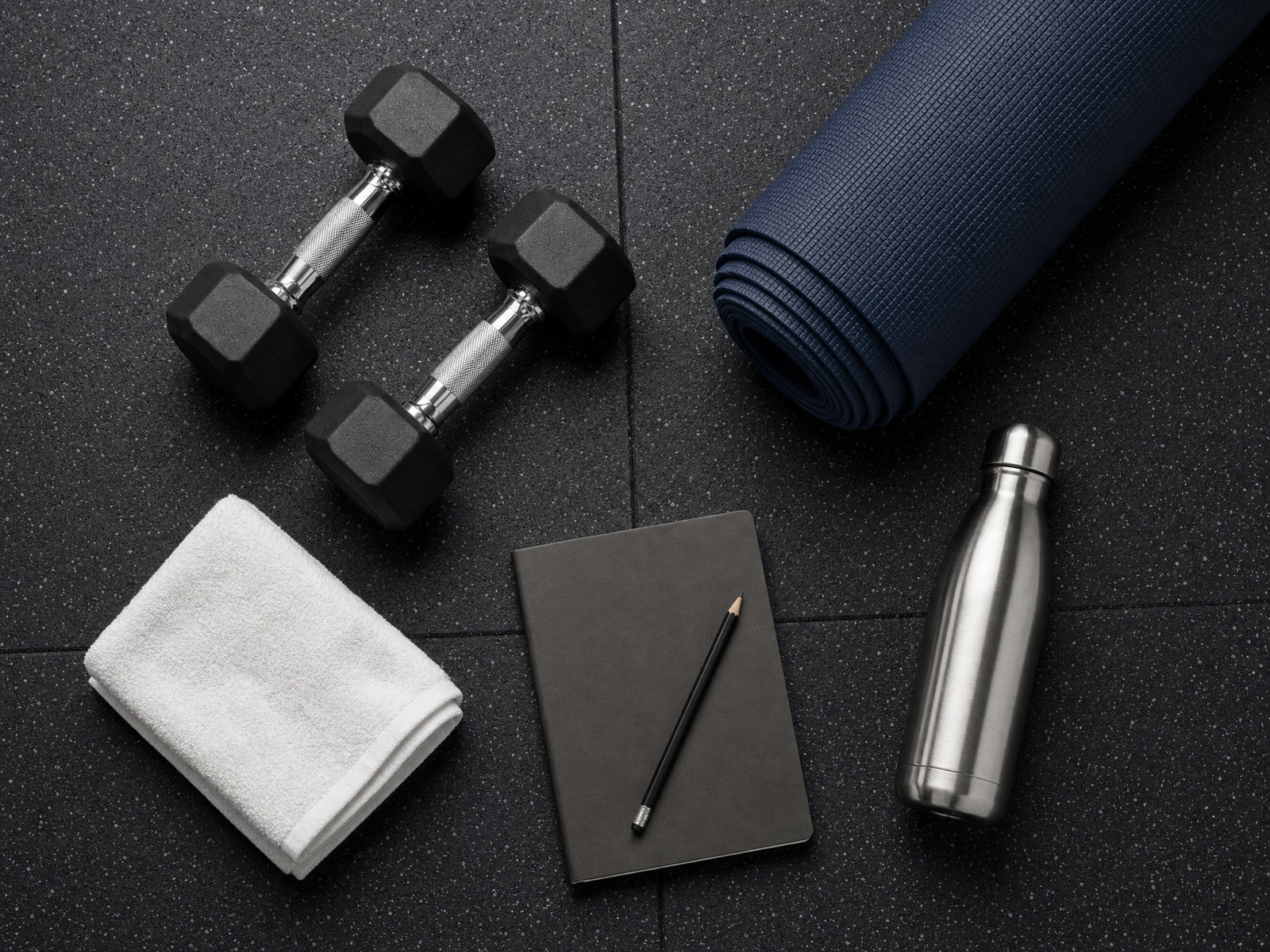
Almost nothing. Comfortable clothes you can move in, flat supportive trainers, a water bottle, and a small towel. Skip the belt, the gloves, the wrist wraps and the pre-workout for now.
The one thing genuinely worth bringing is a way to log your sets — a notes app or a cheap notebook. Beginners who write down what they lifted progress faster, because you cannot apply progressive overload if you can’t remember what you did last time.
Machines or free weights?
Both work. The honest answer for week one is: start with machines and dumbbells, add barbells later.
| Option | Best for | Trade-off |
|---|---|---|
| Machines | Learning a movement safely, training close to failure without a spotter | Fixed path, less carryover to real-world movement |
| Dumbbells | Balanced strength on both sides, easy small jumps in weight | Awkward to get into position once heavy |
| Barbells | Loading heavy, clear long-term progression | Steeper learning curve, usually needs a rack or spotter |
| Cables | Constant tension, huge exercise variety | Stations are often busy at peak times |
If dumbbells are all you have access to, that is genuinely enough — see our full-body dumbbell-only plan.
Your first four weeks
Two alternating sessions, three times a week, with a rest day between each. Week one you alternate A, B, A. Week two you alternate B, A, B, and so on.
| Day | Session |
|---|---|
| Monday | Workout A |
| Tuesday | Rest or easy walk |
| Wednesday | Workout B |
| Thursday | Rest or easy walk |
| Friday | Workout A |
| Saturday | Optional light activity |
| Sunday | Rest |
Start every session with five minutes of easy cardio and one light warm-up set of your first exercise. Rest 90 seconds between sets.
Workout A
| Exercise | Sets | Reps | Watch for |
|---|---|---|---|
| Goblet squat | 3 | 8-10 | Knees tracking out over toes, heels flat |
| Dumbbell bench press or chest press machine | 3 | 8-10 | Elbows around 45 degrees, not flared wide |
| Seated cable row | 3 | 10-12 | Lead with the shoulder blades, not the arms |
| Romanian deadlift (dumbbells) | 3 | 10 | Hips travel back, back stays flat |
| Plank | 3 | 20-30 sec | Ribs down, hips level, keep breathing |
Workout B
| Exercise | Sets | Reps | Watch for |
|---|---|---|---|
| Leg press | 3 | 10-12 | Do not lock the knees hard at the top |
| Lat pulldown | 3 | 10-12 | Pull to the collarbone, chest tall |
| Dumbbell shoulder press | 3 | 8-10 | Ribs down, avoid arching the lower back |
| Walking lunge or split squat | 3 | 8 each side | Front shin roughly vertical |
| Dead bug | 3 | 6 each side | Lower back stays pressed to the floor |
How to pick your starting weight
Pick a weight you could lift for roughly four more reps than the plan asks for. If the plan says 10 and you feel like you could have done 14, that’s about right for week one. It will feel too easy. That is deliberate — you are learning the movement, and starting light is the cheapest insurance against a setback in week two.
By the end of week two, you should be within two or three reps of your limit on the last set.
How to progress: add reps first, then weight
Progressive overload just means making the work gradually harder. There are two straightforward levers, and the useful news is that it doesn’t much matter which you pull.
A 2024 randomised controlled trial in the International Journal of Sports Medicine put 39 previously untrained men and women through 10 weeks of training, randomising each participant’s legs to either load progression or repetition progression. Both groups improved one-rep-max strength and muscle cross-sectional area, with no meaningful difference between the two approaches. Consistency in applying progression mattered more than the method.
In practice:
- Hit the top of the rep range on all sets? Add the smallest weight increment available next session.
- Grinding out the last two reps with shaky form? Stay where you are.
- Stalled twice in a row? Drop the weight by around 10 percent and build back up.
When these four weeks stop feeling hard, add a fourth set to your main lifts before adding a fourth session.
Gym etiquette nobody explains
This is the part that actually keeps beginners at home, so here it is plainly:
- Put your weights back. The single rule everyone agrees on.
- Wipe down benches and pads after use. Most gyms provide spray and paper.
- You can work in. Ask “how many sets have you got left?” — it is completely normal.
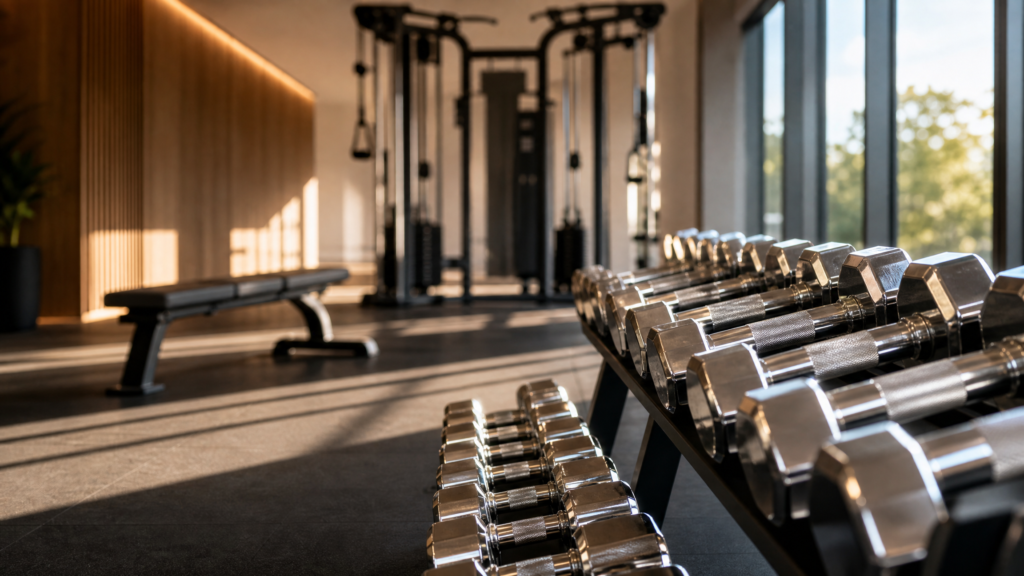
- Don’t stand directly in front of the dumbbell rack. Take the weights and step back a metre.
- Nobody is watching you. Everyone in the room is thinking about their own set.
Common beginner mistakes
- Doing too much in week one. Enthusiasm week one becomes a week-two abandonment. Three sessions, five exercises, done.
- Skipping rest days. Adaptation happens between sessions, not during them. Our piece on why rest days matter covers the mechanism.
- Chasing weight over form. A half-rep with double the load trains less than a full rep done properly.
- Not eating enough around training. See what to eat before and after a workout.
- Quitting at week three. Strength gains in the first month are largely neural. They are real even when the mirror hasn’t caught up.
Frequently asked questions
How long should a beginner gym workout be?
About 40 to 50 minutes including a warm-up. Five exercises at three sets each, with 90 seconds of rest, lands comfortably in that window. Sessions longer than an hour usually mean you are resting too long between sets rather than training harder.
How many days a week should a beginner go to the gym?
Three, with a rest day between sessions. The CDC’s minimum is two days of muscle-strengthening activity per week; three gives you extra practice at the movements without cutting into recovery.
Should beginners do cardio and weights in the same session?
You can, but do the weights first. Five to ten minutes of easy cardio as a warm-up is fine. If you want a longer cardio session, put it after the lifting or on a separate day, so you are not fatigued going into your main work.
How long until I see results from a beginner gym workout?
You will usually feel stronger within two to three weeks as your nervous system adapts to the movements. Visible changes typically take longer — around six to eight weeks with consistent training and adequate protein.
Do I need a personal trainer to start?
No, though one or two sessions can be worth it purely to have someone check your squat and hinge. Most gyms include a free induction — take it, and ask them to walk you through the machines in this plan.
What if the gym is too intimidating?
Go at off-peak hours for the first fortnight — usually mid-morning or early afternoon. Bring the plan written down so you never have to stand around deciding what to do next. If you would rather build a base at home first, start with our 20-minute home workout for beginners.
Sources
- CDC — Adult Activity: An Overview. Physical activity recommendations for adults, including muscle-strengthening frequency.
- Chaves TS, et al. Effects of Resistance Training Overload Progression Protocols on Strength and Muscle Mass. Int J Sports Med. 2024;45(7):504-510. Randomised trial comparing load progression with repetition progression in untrained adults.
This guide is general information, not medical advice. If you have an existing health condition or injury, check with your doctor before starting a new training programme.