Home Workout Plan to Build Muscle Without Weights (Progressive Bodyweight Training)
You can build real muscle without a gym, a barbell, or a single piece of equipment. What you can’t do is build muscle without the one thing that actually drives growth: progressive overload.
Progressive overload means consistently making your training harder over time so your muscles have a reason to keep adapting. In a gym, you do this by adding weight to the bar. At home, you do it five other ways. Learn those five levers and you have a system that produces genuine muscle growth for months without spending anything on equipment.
This guide gives you a full home workout plan to build muscle without weights, the push/pull/legs structure that makes it sustainable, and a clear answer to when bodyweight alone stops being enough.
What you’ll get: The 5 progressive overload levers for bodyweight training, a full 3-day push/pull/legs home plan with exercises and rep targets, week-by-week progression guidelines, and the honest ceiling of bodyweight muscle building.
Can You Actually Build Muscle Without Weights?
Yes. According to Healthline’s review of muscle building science, multiple studies have confirmed that low-load, high-volume resistance training (such as high-rep bodyweight exercises) produces comparable muscle hypertrophy to high-load, low-volume weight training, provided the sets are taken close to muscular failure.
A review by TransparentLabs of the supporting research found that bodyweight exercises produce comparable hypertrophy to weighted training when sets are taken close to failure. The key phrase there is “close to failure.” Ten leisurely push-ups with gas left in the tank won’t build much muscle. Ten push-ups where the last two are genuinely hard will. The stimulus, not the tool, is what drives growth.
The practical limitation of bodyweight training is not that it doesn’t work. It’s that standard bodyweight exercises become too easy over time and you run out of ways to make them harder without equipment. We’ll address this directly, with a plan for both phases.
The 5 Progressive Overload Levers for Bodyweight Training
These are your tools for making training harder without adding external weight:
1. Add reps or sets
The most direct method. If you did 3 sets of 10 push-ups this week, do 3 sets of 12 next week, or add a fourth set. Simple, measurable, and effective for 4-6 weeks before you need to change the lever.
2. Slow the tempo (time under tension)
Ten push-ups where each rep takes 5 seconds is dramatically harder than ten push-ups at normal speed, even though the rep count is identical. Try a 3-second descent, 1-second pause at the bottom, 1-second push. Your muscles will respond to the additional time under load.
3. Reduce rest periods
Rest 60 seconds between sets, then over weeks reduce to 45, then 30. Shorter rest means your muscles are still partially fatigued at the start of the next set, which increases the challenge without changing the exercise.
4. Change the angle or range of motion
Elevating your feet during push-ups shifts load to your upper chest and shoulders. Widening or narrowing your push-up hand position changes which muscles are emphasized. Going deeper in a squat (pause at the bottom) increases the range of motion and muscle challenge. These angle changes are some of the most powerful progression tools available without equipment.
5. Progress to harder exercise variations
This is the ultimate overload lever for bodyweight training. The exercise hierarchy for most movements looks like this:
| Muscle Group | Beginner | Intermediate | Advanced |
|---|---|---|---|
| Chest/triceps | Incline push-up | Full push-up | Diamond / decline push-up |
| Legs/glutes | Bodyweight squat | Jump squat / Bulgarian split squat | Pistol squat |
| Back/biceps | Doorframe row | Elevated inverted row | Pull-up (needs bar) |
| Core | Dead bug / plank | Hollow body hold | L-sit / dragon flag |
| Shoulders | Pike push-up | Decline pike push-up | Wall handstand push-up |
The Home Workout Plan: Push/Pull/Legs Structure
The push/pull/legs split works because it trains each muscle group with enough volume and frequency while allowing adequate recovery. Train each session twice per week (6 sessions total) or once per week with a full-body day added (4 sessions total). Start with three days per week if you’re a beginner.
Day 1 – Push (Chest, Shoulders, Triceps)
| Exercise | Sets | Reps | Tempo |
|---|---|---|---|
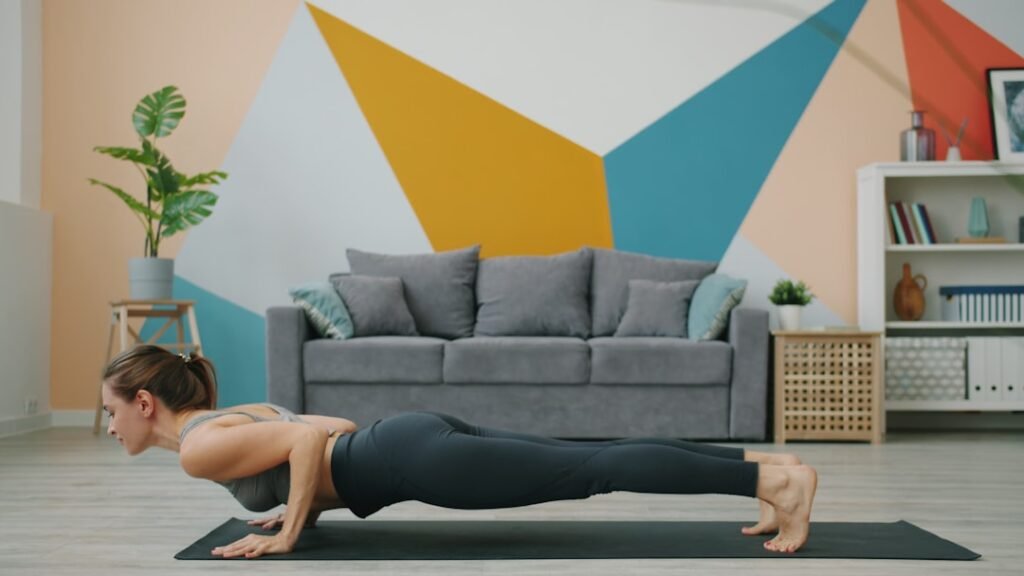
| Push-up (or incline if needed) | 4 | 8-12 | 3-1-1 |
| Pike push-up | 3 | 8-10 | 3-1-1 |
| Diamond push-up | 3 | 8-10 | 2-1-1 |
| Dip (using sturdy chair or parallel surfaces) | 3 | 10-12 | 2-1-1 |
| Plank shoulder tap | 3 | 12 each side | Controlled |
Day 2 – Pull (Back, Biceps)
| Exercise | Sets | Reps | Notes |
|---|---|---|---|
| Doorframe row or inverted row under a table | 4 | 10-12 | Pull chest to bar/surface |
| Superman hold | 3 | 12-15 | 3-second hold at top |
| Reverse snow angel (lying on stomach) | 3 | 15 | Squeeze shoulder blades |
| Towel bicep curl (step on towel, curl handles) | 3 | 12 | Control the descent |
| Dead bug | 3 | 8 each side | Core must stay neutral |
Note on pull training: The back is the hardest muscle group to train without equipment. Doorframe rows and table inverted rows are effective but limited. A $20-30 doorframe pull-up bar is the single best investment for home bodyweight training if you want to progress your back and bicep strength beyond beginner level.
Day 3 – Legs (Quads, Glutes, Hamstrings, Calves)
| Exercise | Sets | Reps | Notes |
|---|---|---|---|
| Squat (add 3-sec pause at bottom) | 4 | 12-15 | Pause creates overload without weight |
| Bulgarian split squat (rear foot on chair) | 3 | 10 each side | One of the best single-leg exercises |
| Single-leg glute bridge | 3 | 12 each side | Drive through heel, squeeze at top |
| Reverse lunge | 3 | 10 each side | Step back, knee doesn’t touch floor |
| Wall sit | 3 | 30-45 seconds | Increase time weekly |
| Calf raises (single leg) | 3 | 15-20 | Use a step if available for range of motion |
Weekly Progression Guide
The key rule: when you can complete all planned reps with good form and 2+ reps left in the tank, progress the exercise the following week. Use this decision tree:
- Can you do all sets and reps with solid form? Yes – add 2 reps per set next week.
- Can you do all sets and reps at the increased count? Yes – slow the tempo (add 1 second to the descent).
- Tempo maxed out? Reduce rest by 10-15 seconds per set.
- Still too easy? Progress to the next variation in the exercise hierarchy.
Track everything. Write down your sets, reps, and which tempo you used. This doesn’t have to be a complicated app. A notes page on your phone works fine. You cannot progress what you don’t track, and looking back at where you started is one of the most motivating things you can do on a plateau day.
What to Eat to Support Muscle Building at Home
Training creates the stimulus for muscle growth. Nutrition provides the materials. The two basics:
- Protein: 0.7-1g per pound of bodyweight daily. Your muscles cannot grow without adequate protein. This is not negotiable. See our high-protein foods guide for sources that fit different budgets and preferences.
- Calories: You need to eat enough to support muscle growth. If you’re in a significant calorie deficit, your body will prioritize survival over building new tissue. A small surplus (100-200 calories above maintenance) supports muscle gain without excessive fat gain.
Post-workout protein within 1-2 hours is beneficial but not magical. Total daily intake matters more than timing. For more on pre and post-workout nutrition, our guide on what to eat before and after a workout has the breakdown.
The Honest Ceiling: When Bodyweight Stops Being Enough
Most people hit the ceiling of bodyweight muscle building around 12-16 weeks, once they’ve mastered the advanced variations in the progression table. At that point, you have a few options:
- Add a pull-up bar (if you haven’t already) – this opens up one of the best upper body exercises available
- Add a set of resistance bands ($15-25) – dramatically extends the range of exercises and difficulty levels
- Add a pair of light dumbbells (10-15lb to start) – opens up isolation exercises and new movement patterns
Continuing with pure bodyweight training beyond this point tends to produce diminishing returns unless you’re specifically interested in calisthenics as a discipline (which is a legitimate goal but a different path). Our beginner strength training program covers the transition to light equipment if you get there.
Frequently Asked Questions
Can you build visible muscle with just bodyweight exercises?
Yes, especially as a beginner. The first 3-6 months of bodyweight training can produce significant visible muscle development, particularly in the chest, arms, and legs, provided you’re applying progressive overload consistently and eating enough protein. The gains slow after this point without adding resistance, but the foundation built is real and substantial.
How long does it take to see muscle gains from home workouts?
Strength improvements are noticeable within 2-4 weeks (neural adaptation). Visible muscle changes typically appear at 6-10 weeks with consistent training and adequate protein. The timeline varies based on starting point, consistency, sleep quality, and nutrition.
Is 3 days per week enough to build muscle at home?
Yes, for most people and especially beginners. Three quality sessions per week with progressive overload produces significant muscle development. The quality of each session, particularly taking sets close to muscular failure, matters more than training frequency at beginner and intermediate levels.
How do I know if I’m building muscle or just losing fat?
These can happen simultaneously (body recomposition), especially in beginners. Signs you’re building muscle: strength increasing in exercises, muscle definition appearing even if scale weight doesn’t change dramatically, clothes fitting differently in specific places (arms, thighs, shoulders). If the scale drops but you’re getting stronger, you’re recomposing well.
Should I do cardio on top of this home workout plan?
Light cardio (20-30 min walks, cycling) can be done on rest days from strength training without interfering with muscle building. High-intensity cardio immediately before strength sessions can reduce performance. Keeping them separated (different times of day or different days) is the simplest approach.
Pick up this plan today. Do the push day. Track your sets and reps. Come back in two weeks and do one more rep per set. Repeat. That’s the entire system. It’s boring to describe and genuinely effective to do.
Pin this plan for your next session, or share it with someone who’s been saying they’ll start working out once they can afford a gym membership.