Somewhere around 40, a lot of women notice the same thing at once: the same eating habits produce a different body, and the workouts that worked at 28 stop delivering. It is easy to read that as decline. It is more useful to read it as a signal that your body has started asking for a different kind of input — and the input it responds to best is resistance.
Weight training after 40 is not about chasing the physique you had in your twenties. It is about building a body that carries you well through the next four decades. This guide covers why lifting matters more now than it did at 25, how to start without hurting yourself, which exercises earn their place, and how to keep going once the novelty wears off.
Why Weight Training Matters More After 40
Adults begin losing muscle mass from roughly their thirties onward, and the rate accelerates through midlife — a process called sarcopenia. Muscle is not just about looking toned. It is where you store glucose, it is what stabilizes your joints, and it is the tissue that determines whether you can get off the floor unassisted at 75. Resistance training is the most effective single lever for slowing and partly reversing that loss — adequate protein matters too, and the two work best together, as the National Institute on Aging and the NSCA position statement on resistance training for older adults both set out.
Bone density and fracture risk
Bone responds to load: when a muscle pulls hard against a bone, the bone adapts by laying down more mineral where the stress is. That matters enormously for women, who lose bone rapidly around menopause as estrogen declines and who account for most osteoporotic fractures.
The training that helps bone is specific — reasonably heavy, and loading the hips and spine. Walking is excellent for many things but does very little for the femoral neck; squats, deadlifts, carries and step-ups do. The LIFTMOR randomized controlled trial put postmenopausal women with osteopenia and osteoporosis through eight months of heavy, supervised lifting and found improvements in spine and hip bone density with no fractures — strong evidence for lifting something meaningful rather than doing endless reps with three-pound weights.
Metabolism, body composition and blood sugar
The claim that muscle “burns hundreds of extra calories a day at rest” is overstated — a pound of muscle burns roughly six calories a day, not fifty. The real benefit is subtler and more valuable: muscle is your largest site of glucose disposal, so more of it improves insulin sensitivity.
Lifting also changes what you lose when you lose weight. Dieting without resistance training strips muscle alongside fat, leaving you lighter but softer and weaker — the exact outcome most women over 40 are trying to avoid. Lift while you diet and a far greater share of the loss comes from fat.
Mood, sleep and cognitive health
Resistance training has a well-documented effect on symptoms of anxiety and depression, comparable in some trials to aerobic exercise. A 2018 meta-analysis in JAMA Psychiatry pooled 33 randomized trials and found a significant reduction in depressive symptoms, regardless of how strong participants actually got. Part of that is neurochemical. A good deal of it is psychological: adding weight to a bar week after week is unambiguous evidence that you are getting better at something, and that evidence is hard to argue with on a bad day. Many women also report deeper sleep once they start lifting, which matters during perimenopause when sleep is often the first thing to go. For a broader overview, the Harvard Health review of strength training benefits is a plainly written summary.
The perimenopause factor
Declining estrogen affects muscle repair, tendon elasticity and bone turnover at once. Practically, that means you have more to gain from training than a 25-year-old does — you are defending against an active loss rather than simply adding on top — and that you may need slightly more recovery and a longer warm-up than you once did. Neither is a reason to train less.
How to Start Safely
Get cleared, especially if something already hurts
Most healthy adults can begin resistance training without a medical consultation. Speak to your doctor first if you have uncontrolled high blood pressure, a heart condition, diagnosed osteoporosis or osteopenia, a recent surgery, or a joint that hurts at rest. A diagnosis rarely rules lifting out — it usually just changes which movements you start with.
Set goals you can actually verify
“Get toned” is not a goal; it is a mood. Goals that work are the ones you can check off without ambiguity:
- Train twice a week for eight consecutive weeks
- Squat to a bench for three sets of eight, holding a 20 lb dumbbell
- Do one full, unassisted push-up from the floor
- Carry the groceries in from the car in a single trip
None of those mention the scale. Early on, the scale is an unreliable narrator — muscle gain and water retention in newly trained tissue can mask real fat loss for weeks. Track strength, photos and how your clothes fit instead.
Choose the minimum viable equipment
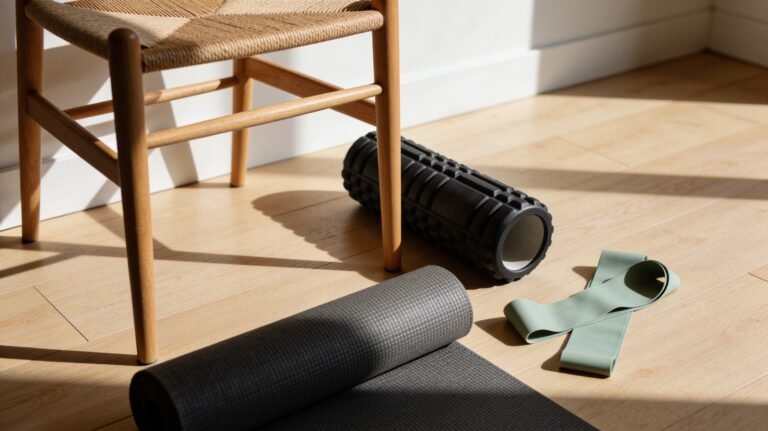
You do not need a full gym to start, and buying one is a common way to spend money instead of training. A pair of adjustable dumbbells, a sturdy bench or chair, and resistance bands will take most beginners through six months of steady progress. In a gym, machines are an underrated starting point: they stabilize the movement for you, so you can focus on effort rather than balance while you learn.
To begin at home, this beginner strength training program for women at home lays out a first block session by session. For the gym, the beginner gym workout guide covers the first four weeks.
The Exercises That Earn Their Place
A productive program is built from a small number of compound movements — exercises that use several joints and large amounts of muscle at once. Six patterns cover almost everything.
Squat: legs, hips and confidence on stairs
The squat trains quadriceps, glutes and core at once, and maps directly onto standing up from a chair — one of the most predictive movements of independence in later life. Start with a box squat: stand in front of a bench, sit back until you touch it lightly, then stand. Progress by holding a dumbbell at your chest, then by lowering the bench.
Hinge: the deadlift and its variations
The hip hinge trains the glutes, hamstrings and posterior chain, and it is the best protector of a lower back you have. Most everyday back injuries happen when someone bends to pick something up with a rounded spine and no trained hip pattern. Learn it with a Romanian deadlift using light dumbbells: soft knees, chest proud, push the hips backwards until you feel a hamstring stretch, then drive the hips forward to stand.
If your lower back is already cranky, build tolerance gradually and pair your training with these stretches for lower back pain relief rather than avoiding hinging altogether.
Push: chest press and overhead press
Horizontal pushing — a dumbbell floor press, bench press or push-up — builds chest, shoulders and triceps. Pressing overhead preserves the shoulder range of motion that quietly disappears in desk-bound decades. Start seated with light dumbbells; if your shoulders complain, a neutral grip with palms facing each other is usually more comfortable than palms forward.
Pull: rows and pulldowns
Pulling is the most commonly skipped pattern and arguably the most valuable for posture. A single-arm dumbbell row, braced on a bench, builds the mid-back muscles that hold your shoulders back and counteract hours spent leaning toward a screen. Aim for at least as much pulling volume as pushing volume — many people benefit from doing more.
Carry and core
Loaded carries — walking 20 meters with a heavy dumbbell in each hand — train grip, core and trunk stability in a way that transfers directly to real life, and they are almost impossible to do with bad form. Add anti-movement core work: planks, dead bugs and Pallof presses teach the trunk to resist rotation and extension. A structured beginner core workout pairs well with two lifting days.
A Simple Weekly Structure
Two full-body sessions per week is a genuinely effective starting dose, and it is achievable in a busy life. Three is better once two is a habit. Here is what a first month might look like:
| Day | Focus | Session |
|---|---|---|
| Monday | Full body A | Box squat, dumbbell floor press, single-arm row, plank |
| Tuesday | Easy movement | 30–45 min walk |
| Wednesday | Rest | Mobility or nothing at all |
| Thursday | Full body B | Romanian deadlift, seated overhead press, lat pulldown, farmer’s carry |
| Friday | Easy movement | Walk, swim or cycle |
| Weekend | Optional | One longer walk, one full rest day |
Three sets of eight to twelve repetitions per exercise is a sensible default. Stop each set with roughly two good repetitions still available — that is close enough to failure to drive adaptation without wrecking your recovery. If you want a fuller structured block, this four-week full body workout plan for women over 40 follows the same logic in more detail.
Progressive overload: the part that actually matters
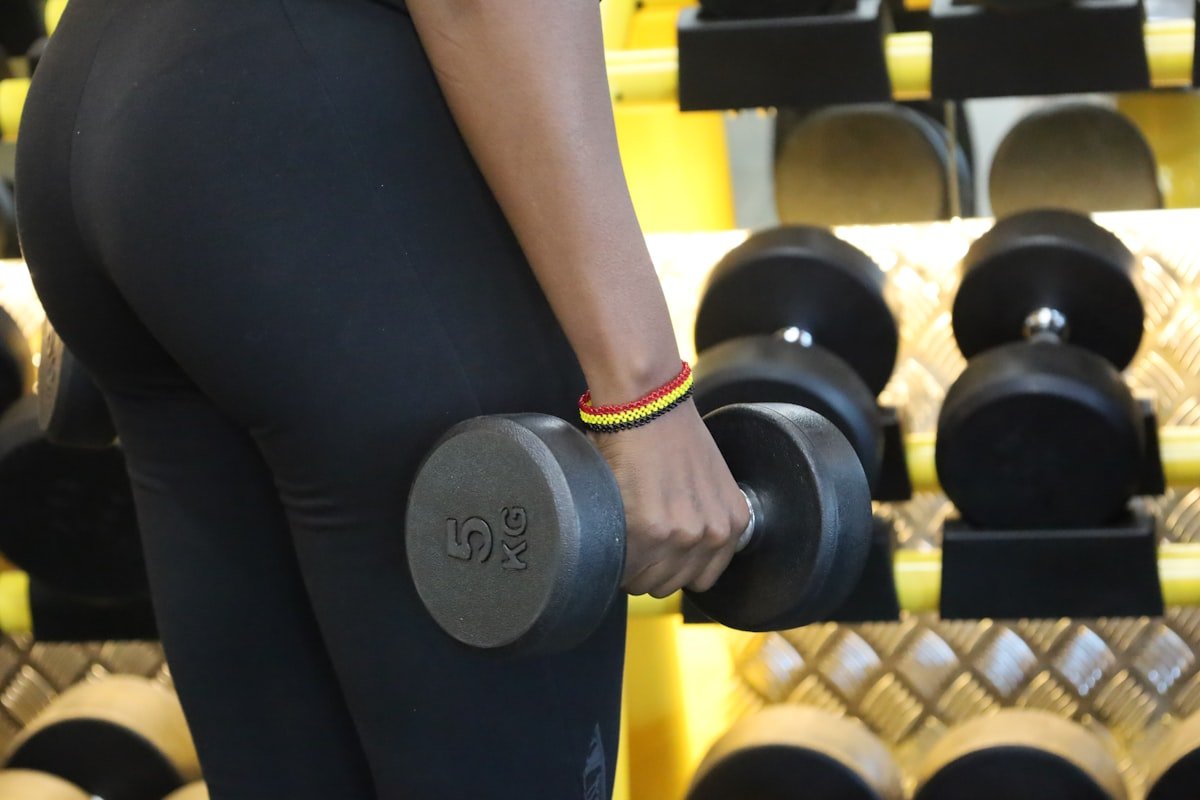
Muscles adapt to demands they have not met before. If the demand never changes, neither does the muscle — which is why the same 5 lb dumbbell routine produces the same body for two years running. Progress however you can: add a rep, add a little weight, slow the lowering phase, shorten the rest, add a set. One small improvement per exercise per session compounds startlingly over a year.
Where cardio and rest fit
Cardio and lifting are complements, not competitors. Two to three easy aerobic sessions a week improve heart health, aid recovery and add very little fatigue; hitting a consistent daily step target is often more sustainable than formal cardio sessions. Rest is where adaptation happens — training is the stimulus, recovery is the response. Leave at least 48 hours between sessions hitting the same muscles, and treat sleep as part of the program, as this piece on why rest days are essential explains.

Eating to Support the Training
Protein: the non-negotiable
Older muscle is less responsive to protein than young muscle — anabolic resistance — so requirements go up rather than down with age. Most active women over 40 do well on 1.2 to 1.6 grams per kilogram of bodyweight daily — in line with the PROT-AGE study group’s recommendations, which put active older adults at 1.2 g/kg or above rather than the 0.8 g/kg general RDA. For a 70 kg woman that is roughly 85 to 110 grams.
Distribution matters as much as the total. Aim for 25 to 35 grams at each main meal rather than a token breakfast and a large hit at dinner. Greek yogurt, eggs, cottage cheese, chicken, fish, tofu, lentils and a simple protein powder make this straightforward — this list of high protein foods covers the options, and the guide to a high protein diet for weight loss helps if fat loss is also a goal.
Hydration, calcium and vitamin D
Even mild dehydration reduces strength output and makes sessions feel harder than they are. Drink through the day rather than trying to catch up during a workout. Calcium and vitamin D deserve attention too, since they underpin the bone adaptations you are training for — but supplement only after talking to your doctor, ideally with a vitamin D blood test to guide the dose rather than guessing.
Getting Past the Common Sticking Points
Soreness that makes you want to quit
Delayed onset muscle soreness peaks 24 to 48 hours after a new stimulus and is normal in the first few weeks. It is not a measure of how good the workout was, and it fades as you adapt. Gentle movement relieves it far better than sitting still — these strategies to recover faster after a workout help. Sharp, localized or joint-centered pain is a different signal: stop and get it assessed.
The fear of getting bulky
This one deserves retiring. Building substantial muscle mass requires years of dedicated training, a calorie surplus and a hormonal profile most women do not have — and it becomes harder, not easier, after 40. What lifting realistically produces is a firmer, more defined shape at the same or lower bodyweight. Nobody accidentally becomes a bodybuilder.
Motivation that evaporates in week three
Motivation is a starting fuel, not a sustaining one. Structure sustains training: the same days each week, sessions short enough that skipping is not tempting, and a written log. On low days, lower the bar rather than skip — a ten-minute session preserves the habit, and the habit is the asset. More tactics for the flat weeks: how to stay motivated to exercise.
Tracking Progress Without Obsessing
Write down the exercise, weight, sets and repetitions for every session. A notebook is enough; an app is faster to search. The log turns vague effort into visible progress and tells you what to add next time rather than leaving you guessing. Wearables are useful for trends in sleep, resting heart rate and steps, but treat their calorie estimates as loose approximations. Reassess every eight to twelve weeks: if the numbers in your log are going up, the program is working, whatever the scale said that morning.
Frequently Asked Questions
Is it too late to start weight training at 50 or 60?
No. Studies of resistance training in adults in their seventies, eighties and nineties consistently show meaningful gains in strength, muscle size and functional ability. Beginners see the fastest relative improvements of anyone, and the older you are, the more the outcome affects your daily independence.
How many days a week should a woman over 40 lift weights?
Two full-body sessions a week is enough to produce real strength and bone benefits, and it is the dose most people can sustain. Three sessions accelerate progress once two are consistent. More than four rarely helps beginners and often compromises recovery.
How heavy should the weights be?
Heavy enough that the last two or three repetitions of a set are genuinely difficult while your form stays clean. If you could do fifteen repetitions but stop at ten, the weight is too light to drive much adaptation. Increase the load whenever you can complete all your sets at the top of the target repetition range.
Will weight training help with menopause weight gain?
It helps with body composition, which is usually the real complaint. Lifting preserves the muscle that dieting alone would strip away, improves insulin sensitivity, and changes shape even when the scale moves slowly. Combined with adequate protein and a modest calorie deficit, it is the most reliable approach available.
How long before I see results?
Strength improves within two to three weeks, largely through neural adaptation. Visible changes in shape typically take eight to twelve weeks. Bone density changes are slower still, measurable over six to twelve months. The early wins are in the logbook, which is exactly why keeping one matters.
The Bottom Line
Weight training after 40 is not a cosmetic project with a health side effect. It is a health project with a cosmetic side effect. Two sessions a week, six basic movement patterns, enough protein, and the patience to add a little each time will do more for the next thirty years of your life than any supplement, cleanse or piece of cardio equipment.
Start lighter than your ego wants. Write it down. Show up again on Thursday.
This article is for general information and is not medical advice. Speak to your doctor before starting a new exercise program, particularly if you have an existing health condition.