High protein diet for weight loss: meal plans and food lists for beginners
I spent three months eating “healthy” and going to the gym four times a week before I realized I was eating roughly the same calories I’d consumed before I started exercising. My workouts felt harder but the scale didn’t budge. The problem wasn’t my effort. The problem was that I’d ignored the one thing that actually moves the needle: what I put on my plate. That’s when I learned about protein, and it changed how I approached weight loss completely.
This post contains affiliate links. If you buy through them, I earn a small commission at no extra cost to you.
A high protein diet for weight loss isn’t about eliminating carbs or jumping into extreme restriction. It’s about eating more of one macronutrient (protein) so that everything else falls into place naturally: you stay full longer, you maintain muscle while losing fat, and you don’t have to white-knuckle your way through hunger all day. This matters because most people fail at weight loss not because the diet is wrong, but because they can’t stick to it.
If you’re a beginner looking at nutrition for the first time, this guide will walk you through exactly how much protein you need, what foods to eat, and how to build a meal plan that you’ll actually follow.
TL;DR
- Aim for 1.6 to 2.2g of protein per kilogram of bodyweight (0.73 to 1g per pound) when losing weight
- High protein helps preserve muscle, keeps you full longer, and has a higher thermic effect than carbs or fat
- Start with a 300-500 calorie deficit below your maintenance calories, not a drastic cut
- Simple foods work best: chicken, eggs, Greek yogurt, cottage cheese, lean beef, fish, beans, and lentils
- A beginner meal plan uses 3 meals and 1-2 snacks, with protein at every meal, taking about 20-30 minutes to prepare per day
How much protein do you actually need for weight loss?
The most common mistake I see is people eating the standard dietary recommendation (0.8g per kilogram of bodyweight) while trying to lose fat. That target works fine for sedentary people maintaining their weight. When you’re in a calorie deficit and lifting weights or doing resistance training, you need more.
Research consistently shows that 1.6 to 2.2g of protein per kilogram of bodyweight is optimal for fat loss while preserving muscle. If you’re 80kg (176 lbs), that’s 128 to 176g of protein per day. If you’re 70kg (154 lbs), aim for 112 to 154g.
Why does this matter? Three reasons:
Satiety. Protein is the most filling macronutrient. When you eat chicken breast instead of crackers, your stomach stays satisfied longer. You eat less overall without feeling deprived.
Muscle preservation. In a calorie deficit, your body is willing to lose muscle along with fat. Higher protein intake tells your body to keep the muscle and burn fat instead. This matters because muscle determines your metabolism.
Thermic effect. Your body burns calories digesting food. Protein requires about 25% of its calories to digest, compared to 5-10% for carbs and 0-3% for fat. This is a small but real advantage.
Who this works for: Anyone trying to lose weight while maintaining or building muscle. Especially people doing resistance training or strength work at home.
Common mistake: Eating high protein but not tracking total calories. You can absolutely gain weight eating lots of chicken if you’re eating 3,000 calories when you should be eating 2,000. Protein is a tool that helps you stick to your calorie target, not a loophole around it.
Understanding calorie deficit and protein together
You’ve probably heard that weight loss is calories in versus calories out. That’s true but incomplete. A calorie deficit is necessary, but the composition of those calories matters for how you feel and whether you can stick to it.
First, figure out your maintenance calories. This is the amount you’d eat to stay at your current weight. Use an online calculator (many free ones exist) or estimate: your bodyweight in pounds multiplied by 12 to 15 is a rough starting point. A 180-pound person typically maintains at around 2,160 to 2,700 calories depending on activity level.
A deficit of 300 to 500 calories below maintenance is aggressive enough to see results (0.5 to 1 pound per week) but conservative enough that you’re not miserable. So if your maintenance is 2,400 calories, aim for 1,900 to 2,100.
Now, here’s where protein comes in. If you eat 150g of protein per day at 1,900 calories, you’ve allocated 600 of those calories to protein (4 calories per gram). That leaves 1,300 calories for carbs and fat. This is much more livable than trying to make 1,900 calories work on 80g of protein.
Who this works for: Anyone new to calorie tracking who finds hunger the biggest barrier.
Common mistake: Starting with a 1,000+ calorie deficit thinking you’ll lose faster. You won’t. You’ll be hungry, irritable, and you’ll quit by week three. Slow and sustainable wins.
High protein low carb diet for weight loss versus balanced macros
There’s a common assumption that weight loss requires cutting carbs dramatically. It doesn’t. You can lose weight eating reasonable carbs as long as total calories are in a deficit.
Here’s the honest comparison:
High protein, low carb (e.g., 40% protein, 25% carbs, 35% fat). Works well for some people. You feel full quickly. Carbs like bread and pasta become occasional treats, which removes a temptation for many people. Downsides: you might feel flat in workouts, it’s harder to eat socially, and if you don’t like meat and eggs, it’s restrictive.
High protein, balanced carbs (e.g., 35% protein, 40% carbs, 25% fat). Works equally well for fat loss as long as calories are right. You can eat more volume of food because carbs are less calorie-dense than fat. Workouts often feel better. Downsides: you have to be more intentional about portions since carbs are easy to overeat.
The science: neither approach is superior for weight loss. A 2020 meta-analysis found no significant difference in fat loss between high protein low carb and high protein moderate carb diets when calories are matched. The best diet is the one you’ll actually follow.
My recommendation for beginners: start with balanced macros (roughly equal carbs and fats, higher protein) because it’s more forgiving socially and you don’t feel like you’re giving up entire food groups. If you try it for two weeks and find you’re snacking too much on carbs, shift lower. But don’t start restrictive.
Who this works for: People who like flexibility and don’t want to eliminate foods entirely.
Common mistake: Thinking “low carb” means no carbs. Even on a lower carb diet, you’re eating 100-150g per day, not zero. Zero carb diets are unsustainable for most people and unnecessary for weight loss.
High protein weight loss meal plan for beginners
The biggest barrier to starting is complexity. Most meal plans I see online have 5-6 different recipes per week, specialty ingredients, and 45 minutes of prep time. That’s not sustainable for beginners.
Instead, use what I call the “formula approach”: one protein, one starch, one vegetable, repeated. You prepare three versions of this combination on Sunday for lunch and dinner all week, with breakfast and snacks separate.
Sample day (2,000 calories, 150g protein)
Breakfast (380 calories, 25g protein)
- 2 whole eggs plus 3 egg whites scrambled
- 1 slice whole wheat toast
- 1 tablespoon peanut butter
Mid-morning snack (150 calories, 20g protein)
- Greek yogurt (150g / 5.3 oz) with 30g berries
Lunch (520 calories, 40g protein)
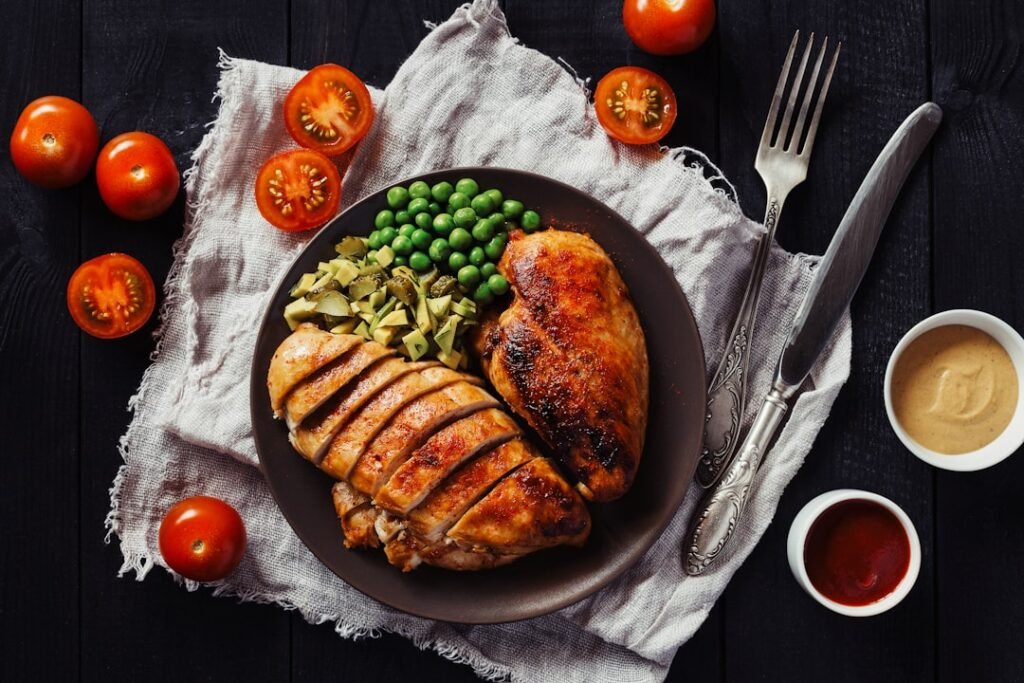
- 150g chicken breast (grilled or pan-seared)
- 150g white rice or sweet potato
- 100g broccoli with 1 tablespoon olive oil
Afternoon snack (180 calories, 15g protein)
- Protein bar or 30g mixed nuts
Dinner (770 calories, 50g protein)
- 200g lean ground beef (5% fat) or salmon
- 200g brown rice or pasta
- 150g mixed vegetables
Total: 2,000 calories, 150g protein
This is not fancy. It’s not Instagram-worthy. But it’s predictable, the ingredients are cheap, you can buy them anywhere, and once you cook it three times you don’t have to think.
Foods for your high protein weight loss list
Proteins (aim for 25-50g per serving)
- Chicken breast (31g protein per 100g)
- Ground beef, 5-10% fat (21g per 100g)
- Salmon or white fish (25g per 100g)
- Eggs (6g per egg)
- Greek yogurt (10g per 100g)
- Cottage cheese (11g per 100g)
- Canned tuna (26g per 100g)
- Protein powder (20-25g per scoop)
- Lentils or beans (9g per 100g cooked)
- Turkey
Carbs (eat with protein to slow digestion)
- White or brown rice
- Sweet potatoes
- Oats
- Whole wheat bread
- Pasta
- Cereal (plain, not sugary)
Fats (needed for hormones and absorption)
- Olive oil
- Nuts
- Avocado
- Butter
- Fatty fish (salmon, mackerel)
Vegetables (eat freely, mostly water and fibre)
- Broccoli
- Spinach
- Kale
- Carrots
- Peppers
- Green beans
- Asparagus
Protein powder deserves a line: it’s the one supplement I recommend because it’s cheap, convenient, and solves the “quick breakfast” problem. A 1kg tub costs about 15-25 dollars and gives you 30-40 servings. It’s not necessary, but it helps many people hit their target.
Who this works for: People who work long hours and need predictability, or anyone new to meal prep.
Common mistake: Buying pre-prepared meals or protein bars thinking you’re saving time but spending 3x the money. Those are fine occasionally, but buying raw chicken and rice is 70% cheaper and takes the same amount of time if you batch cook.
Does high protein help with weight loss: the evidence
The yes-it-works answer: yes, higher protein intake makes weight loss easier and more sustainable than low protein diets when calories are equal. It improves satiety, preserves muscle, and has a measurable thermic effect.
But here’s what actually matters: high protein is one tool. By itself, it doesn’t create weight loss. You still need a calorie deficit. Someone eating 3,000 calories at 200g protein daily will not lose weight, no matter how much protein they eat.
The practical reframe: high protein doesn’t do the work for you, but it makes it dramatically easier to do the work yourself. It keeps you full so you’re not white-knuckling through hunger. It preserves muscle so you look better when the fat comes off. It’s not magic, but it’s leverage.
Studies back this: a 2014 review in the American Journal of Clinical Nutrition found that higher protein diets led to greater weight loss and fat loss than lower protein diets on the same calorie target. The average difference was 1.5 to 2kg more fat loss over 8-12 weeks. Not dramatic, but real.
Who this works for: Anyone struggling with hunger on a diet, or anyone who lifts weights and wants to maintain muscle while losing fat.
Common mistake: Thinking protein alone will create a deficit. You still have to eat fewer calories than you burn. High protein makes that easier, not automatic.
Building your first week: practical steps
Week one is about getting the baseline. You don’t need to hit your protein target perfectly or go full-meal-prep mode. You need to establish what a high protein eating day looks like and see if it feels sustainable.
Monday: track what you normally eat. Download MyFitnessPal or Cronometer. Log everything you eat for one day without changing anything. Don’t judge it. Just see the numbers: calories, protein, carbs, fat. Most people are shocked. They either underestimate how much they eat, or they eat 60g of protein when they need 120g.
Tuesday and Wednesday: add one high protein meal. Whatever your breakfast normally is, replace it with eggs or Greek yogurt and oats. That’s it. See how you feel at lunch. Most people notice they’re less hungry by 11am.
Thursday and Friday: plan Sunday meal prep. Pick one chicken and rice recipe, one ground beef and sweet potato recipe. Write down the exact quantities so you know the calories. Buy the ingredients Friday evening.
Saturday: do the prep. Grill the chicken. Brown the beef. Cook rice. Cook vegetables. It takes 45 minutes total if you do it all at once. Portion into containers. Refrigerate.
Sunday through the following Friday: eat your prepped meals for lunch and dinner. Breakfast and snacks are flexible but try to hit your protein target. Track in your app so you see the pattern.
By day 7, you’ll know if this approach works for you. If it does, repeat. If it doesn’t, adjust: maybe you need more carbs, maybe you need different proteins, maybe meal prep feels too rigid and you’d rather buy rotisserie chicken instead.
Who this works for: Anyone starting weight loss for the first time.
Common mistake: Trying to do everything perfectly from day one. You’ll burn out. Start with one change, add another next week.
High protein diet versus extreme calorie restriction: which actually works
The allure of extreme restriction is obvious: cut calories in half, lose weight twice as fast. The problem is that humans are not thermometers. Your body adapts. Your hunger hormones spike. Your energy crashes. By week three, your willpower is gone.
Extreme restriction also typically results in muscle loss because there aren’t enough calories to support both your workouts and your body’s basic functions. You lose weight, but a lot of it is muscle. When you stop the diet (and you will), you gain it back as fat because your metabolism is lower.
A moderate deficit with high protein is slower (0.5-1 pound per week instead of 2-3 pounds) but sustainable, preserves muscle, and the weight stays off because you’ve actually built a habit, not relied on willpower.
The math: a 1,000 calorie per day deficit would theoretically lose 1kg per week (1kg of fat is 7,700 calories). But you can’t sustain 1,000 calorie restriction long-term. A 300-500 calorie deficit is achievable, leads to 0.5-1kg per week, and feels like a normal life, not a punishment.
The timeline matters here too. Most beginners expect results in 2 weeks. Real change takes 6-8 weeks to see visually, and that’s if you’re consistent. If you’re looking for faster, you’re setting yourself up to quit.
Who this works for: Anyone who has tried extreme restriction before, noticed the crash, and is ready for a different approach.
Common mistake: Comparing your week 2 to someone else’s week 12. Early progress is fast (a lot is water loss). It slows down. That’s normal and expected.
High protein diet for weight loss versus keto
Keto gets discussed a lot in weight loss conversations, so it’s worth being clear about how high protein moderate carb stacks up.
Keto (very low carb, high fat) works for weight loss, but not because ketones are magic. It works because it’s hard to overeat fat, so people naturally eat fewer calories. Some people find very low carb makes them feel satiated on fewer calories.
But keto has trade-offs: workouts feel flat without carbs, it’s restrictive socially, and many people find it unsustainable long-term. The research on long-term weight loss shows no advantage for keto versus other moderate deficit diets.
High protein moderate carb (with controlled fat) works equally well for fat loss, feels better for most people doing any kind of training, and is easier to stick to because you’re not eliminating entire food groups.
Pick whichever one you’ll actually follow. If you hate carbs, go keto. If you love carbs and find them helpful for workouts, go moderate carb. The physics of weight loss is the same: deficit equals fat loss.
Who this works for: Anyone trying to decide between common diet approaches.
Common mistake: Thinking one diet is objectively better. They’re tools. Different tools work for different people.
Sample meal prep shopping list
Here’s what you buy on Friday for Sunday prep. Total cost is around 25-35 dollars for five days of lunch and dinner. All items are available at any supermarket.
Proteins
- 2kg chicken breast (12-16 dollars)
- 1kg lean ground beef (8-12 dollars)
Carbs
- 2kg rice or pasta (3-4 dollars)
- 1kg sweet potatoes (2 dollars)
Vegetables
- 500g broccoli (2 dollars)
- 500g spinach or mixed vegetables (2-3 dollars)
- 1kg carrots (1 dollar)
Oils and seasonings
- Olive oil (you probably have this)
- Salt, pepper, garlic powder (you probably have these)
Total: 30-40 dollars for 10 meals (5 lunch and 5 dinner) is about 3-4 dollars per meal
This is cheaper than a single fast food meal and higher protein than most restaurant food.
Tracking and adjusting your high protein weight loss plan
After two weeks of following a high protein plan, you’ll have data: how many calories you actually ate, how much protein you managed, whether you lost weight.
If you lost 0.5 to 1kg, the plan is working. Keep going. If you lost nothing, you’re probably eating more than you think. Use a food scale for one week to verify portions (people consistently overestimate portion sizes). If you lost 2+ kg, the deficit is working but might be too aggressive; you’ll likely feel it in week three as hunger and fatigue spike.
As you lose weight, your calorie needs change. Someone who weighed 100kg needs fewer calories at 90kg. If you’re not seeing progress by week 5-6, reduce calories by 100-150 and reassess.
Protein intake is easier to adjust: if you’re hitting your target and feel full, keep it. If you’re hungry by 3pm, add 20-30g more protein at breakfast.
Who this works for: Anyone serious about long-term changes who wants data, not guesswork.
Common mistake: Obsessing over daily fluctuations. Weight bounces 1-2kg based on water retention, food timing, and hormones. Look at the trend over a week or month, not a single day.
Equipment recommendations for meal prep
You don’t need much to prepare high protein meals, but a few tools make the process faster.
Budget (under $20)
- A basic kitchen scale (Ozeri is solid, 8-12 dollars). You need this to understand portions. Not optional.
- One decent chef’s knife (12-15 dollars). A sharp knife is safer and faster than a dull one.
Mid-range ($20-60)
- Meal prep containers with divided trays (30 dollars). Glaslock brand is reliable. You need about 10 containers to meal prep 5 days of lunches and dinners.
- Immersion blender (35-50 dollars). Nice for making protein smoothies and soups, but optional.
Best overall
- Instant Pot or electric pressure cooker (60-80 dollars). Cooks chicken and rice simultaneously in 15 minutes. Actually saves time on prep day. Many people find it worth it.
Realistically, all you need is a scale, a knife, and containers. The rest is nice but optional.
Frequently Asked Questions
How quickly will I see results on a high protein diet for weight loss?
You’ll see the scale move in 5-7 days, but most of that is water loss from the calorie deficit. Real fat loss appears around week 4-6 when you notice clothes fitting differently or your face looking leaner. Aim for 8-12 weeks before deciding if the approach is working for you.
Can I do high protein on a vegetarian diet?
Yes. Greek yogurt, cottage cheese, eggs, beans, lentils, and plant-based protein powder all work. You’ll eat slightly larger volumes because plant proteins are often less calorie-dense, but the target is the same: 1.6-2.2g per kilogram of bodyweight.
Does protein powder count toward my daily protein target?
Yes, it’s just food. 25g of protein from a powder is identical to 25g from chicken in terms of muscle building and satiety. Real food is fine, powder is fine, a mix of both is fine.
What if I don’t like tracking calories?
You can estimate. A palm-sized portion of protein (about 100g) is roughly 25-30g of protein. A fist-sized portion of carbs is roughly 40-50g. A thumb-sized portion of fat is roughly 10-15g. This works for rough calorie awareness. For weight loss, you’ll probably need one week of actual tracking so you understand what your eating patterns look like, then you can estimate more confidently.
—
You don’t need to change your entire life this week. You need to pick one thing: add one high protein meal, track one day, or buy a kitchen scale. Whichever one feels easiest is the right starting point. Protein is just a tool that makes the deficit easier, not the hard part itself. The hard part is showing up consistently, and that starts with a single choice.