This 30-day home workout challenge needs zero equipment, about 20–25 minutes a day, and one floor. It is built in four weekly phases so the difficulty rises with you — the most common reason challenges fail is a flat plan that is too hard on day 1 and too easy on day 30. Every move has an easier and harder version, and rest days are scheduled, not optional.
How the challenge is structured
- Week 1 — Foundation: learn the six base moves, shorter sets, focus on form.
- Week 2 — Volume: same moves, more rounds.
- Week 3 — Intensity: harder variations and shorter rests.
- Week 4 — Peak: combined circuits and a final “test day” to measure progress against day 1.
- Schedule: 5 workout days, 1 active recovery day (walk + stretch), 1 full rest day per week.
The six base moves (and how to scale them)
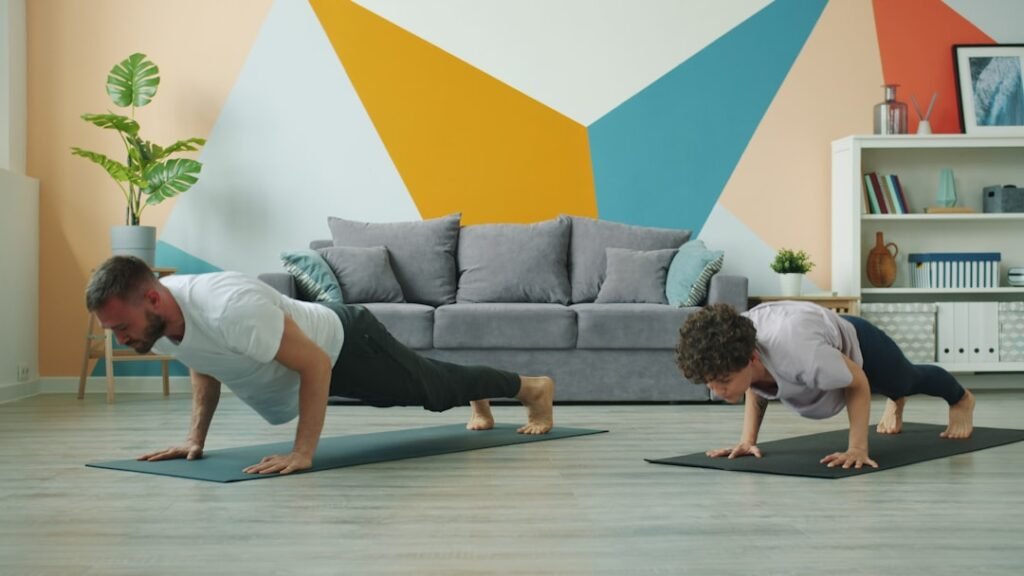
Squats (easier: to a chair · harder: jump squats) · Push-ups (easier: on knees or against a wall · harder: decline) · Glute bridges (harder: single-leg) · Plank (easier: on knees · harder: shoulder taps) · Reverse lunges (harder: jump lunges) · Mountain climbers (easier: slow step-ins · harder: sprint pace). Form beats reps every single day of this plan — if form breaks, take the easier version and keep moving. For extra core focus, our beginner core workout slots into any rest-day gap.
Week-by-week daily plan
Week 1 (days 1–7): 3 rounds of 10 squats, 8 push-ups, 12 glute bridges, 20-second plank, 8 lunges/leg, 20 mountain climbers; 60–90s rest between rounds. Day 4 active recovery, day 7 rest. Week 2 (8–14): 4 rounds of the same, plank to 30 seconds. Week 3 (15–21): 4 rounds, upgrade two moves to their harder versions, rest cut to 45–60s. Week 4 (22–30): 5 rounds as a circuit with 30–45s rest; day 29 easy walk; day 30 test day — max squats in 1 minute, max push-ups unbroken, max plank hold; compare with your day-1 numbers.
What results to expect (honestly)
In 30 days most beginners see: noticeably more reps on test day, easier stairs and daily movement, better sleep, and firmer legs and core. What 30 days will not do: dramatic visible transformation — that arrives at the 8–12 week mark and depends heavily on eating; pair the plan with our healthy eating habits and budget meal prep guides. The CDC activity guidelines (150 minutes moderate activity weekly plus 2 strength days) are met by this plan from week 1 — you’re not under-training by going short and consistent.
Rules that make people finish
- Same time daily. Attach it to an anchor (before shower, after school run) — decision-free repetition is the whole trick.
- Missed a day? Resume, never double up. Doubling causes the soreness that ends challenges.
- Soreness is fine; joint pain is not. Sharp pain means stop and scale down — and anything persistent deserves a professional’s eyes. If you’re new to exercise or have a health condition, check with your doctor before starting.
- After day 30: repeat the challenge with harder variations, or graduate to our full-body calisthenics program. Daily walking targets from our steps guide stack neatly on top.
30 day home workout challenge no equipment: frequently asked questions
Can I lose weight with a 30-day home workout challenge?
Some — typically 1–2 kg if eating stays steady — but the bigger 30-day wins are strength, energy and habit. Meaningful fat loss is mostly decided in the kitchen.
Is 20 minutes a day enough to see results?
Yes for beginners — 20–25 focused minutes, five days a week, meets public-health strength and activity guidance and produces measurable strength gains in 4 weeks.
What if I can’t do a push-up?
Start against a wall, progress to a countertop, then knees, then full — the challenge’s scaling system is designed exactly for this, and wall-to-floor progression within 30 days is common.