Learning how to wake up and work out is mostly a planning problem, not a willpower problem. Many people find morning exercise easier to keep up, because competing priorities have not appeared yet. This guide explains why, gives you a complete 20-minute morning workout routine you can do at home, and shows the habits that make waking up to train sustainable. It is general information, so adjust anything that does not suit your body or schedule.
Why Morning Exercise Has a Consistency Advantage
Your day gets busier as it goes on. Meetings run late, family needs appear, and energy dips. A morning session happens before most of that can interfere, which is why many people report skipping fewer workouts when they train early. Some people also feel more alert and settled for the rest of the morning afterward, though how much varies from person to person.
The research on the best time of day to exercise is mixed, and the physical benefits appear broadly similar whenever you train. So the real advantage is behavioural: if morning is the slot you can protect, it is a good one. If you are curious about building a longer routine around it, our healthy morning routine for mind and body is a natural next read.
❓ Quick Knowledge Check
What is the most reliable strategy for consistently waking up earlier to exercise?
Start With Sleep, Not the Alarm
The biggest barrier to a morning workout is usually not the alarm. It is the night before. If you are sleeping five hours, a 6 a.m. session will feel miserable, and you will quit within a week. Most adults do best with roughly seven or more hours of sleep, according to public health guidance such as the CDC sleep information page.
Work backwards from your wake time. If you want to be up at 6:30, aim to be asleep around 11 p.m. or earlier, then protect that bedtime like an appointment. Keep screens out of bed, keep the room cool and dark, and avoid heavy meals or caffeine late in the day. Our guide to sleep habits that support fitness covers this in more detail.
If you regularly struggle to sleep or feel exhausted despite enough hours in bed, speak with a healthcare professional rather than trying to push through with earlier alarms.
Your Complete 20-Minute Morning Workout
This routine requires no equipment, and the first 4 minutes serve as a dynamic warm-up. Many people do it soon after waking, once they are fully up and moving. Start gently, since your joints and muscles can feel stiffer first thing. If you want a lower-impact option, swap the jump squats for fast bodyweight squats. For a longer alternative, see our 20-minute home workout for beginners.
| Minutes | Exercise | Reps / Duration | Purpose |
|---|---|---|---|
| 0:00–1:00 | March in place + arm swings | 60 sec continuous | Wake the nervous system |
| 1:00–2:00 | Hip circles + neck rolls | 10 each direction | Joint mobility |
| 2:00–3:00 | Bodyweight squat (slow) | 10 reps, 3-sec down | Lower body activation |
| 3:00–4:00 | Inchworm to push-up position | 5 reps | Hamstring + shoulder warmup |
| ⇩ Main Circuit (3 rounds, ~30 sec per exercise, 15 sec rest) | |||
| 4:00–6:00 | Jump squats (or fast squats) | 30 sec on / 15 sec off | Lower body power |
| 6:00–8:00 | Push-ups | 30 sec on / 15 sec off | Upper body strength |
| 8:00–10:00 | Mountain climbers | 30 sec on / 15 sec off | Core + cardio |
| 10:00–12:00 | Reverse lunges alternating | 30 sec on / 15 sec off | Glutes + quad balance |
| 12:00–16:00 | Repeat circuit, Round 2 | Same as above | Cardiovascular development |
| 16:00–18:00 | Plank hold | 3 × 20 sec with 10 sec rest | Core endurance |
| 18:00–20:00 | Cool-down — child’s pose, hip flexor stretch, cat-cow | 60 sec each | Recovery + flexibility |
6 Strategies to Actually Wake Up and Train
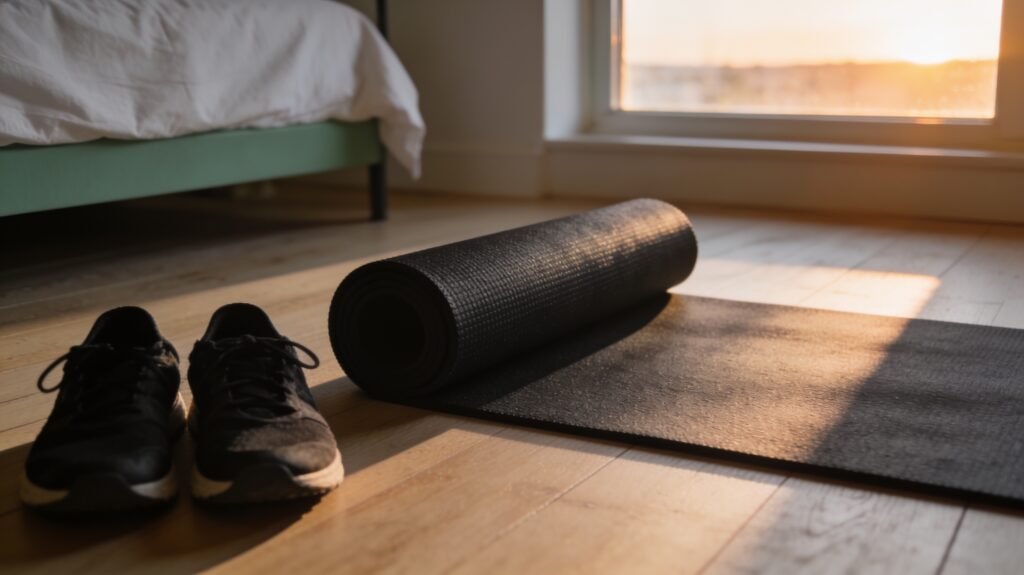
- Prepare everything the night before: lay out workout clothes, fill your water bottle, place your shoes at the bedside. Every decision you eliminate the night before is one less barrier in the morning.
- Shift your alarm gradually: move your wake time 15 minutes earlier every 3–5 days. A sudden 60-minute shift creates sleep deprivation that makes morning training unsustainable.
- Don’t negotiate: the 5-minute rule — commit to just 5 minutes of movement. Almost everyone continues past 5 minutes once the body is moving.
- Cold water on face immediately: cold water stimulates the dive reflex, rapidly activating the nervous system. One of the fastest reliable tools for clearing morning grogginess.
- Move your alarm across the room: forcing yourself to stand up to turn off the alarm is the single most effective strategy for preventing the snooze trap.
- Anchor to an existing routine: pair the workout immediately after an existing morning behaviour. Habit stacking eliminates the need for daily willpower.
⚙ Night-Before Checklist
✓ Workout clothes laid out or worn to sleep
✓ Water bottle filled and by the bed
✓ Alarm placed across the room
✓ Phone on airplane mode until after the workout
✓ Tomorrow’s session written down
▶ WATCH: 20-Minute Morning Workout — Follow Along
🔍 Watch on YouTubeWhat to Eat (or Not) Before a Morning Workout
There is no single right answer here. Some people feel great training on an empty stomach, and others feel dizzy or weak. A short 20-minute session does not usually require fuel, but experiment and see how you feel.
- If you feel flat or lightheaded: try a small snack 30 to 60 minutes before, such as half a banana, a slice of toast, or a small yoghurt.
- If food makes you queasy: try a few sips of water and eat a proper breakfast afterward.
- Hydrate first: you wake up after hours without fluids, so a glass of water before you start is a simple upgrade.
- Eat afterward: a breakfast with protein and carbohydrate, such as eggs and fruit, supports recovery and keeps you full.
If you have diabetes, take medication that affects blood sugar, or have any condition that makes fasted exercise risky, check with your doctor before training before breakfast.
A Simple 4-Week Ramp-Up
Do not jump from zero to six mornings a week. A gradual build gives your body and your schedule time to adjust.
- Week 1: Do the 4-minute warm-up and one round of the circuit, two mornings. Wake up at your normal time if you need to.
- Week 2: Wake 15 minutes earlier. Do two rounds of the circuit on three mornings.
- Week 3: Wake another 15 minutes earlier if you feel rested. Do the full routine on three mornings and add a walk on another.
- Week 4: Keep three or four mornings a week and take at least two rest days. Add a short stretch from our morning yoga stretches on rest days.
If you want a more detailed week-by-week structure, our beginner morning workout routine goes further, and how to build a workout habit that sticks explains the habit side.
Common Mistakes
- Cutting sleep to fit the workout. Trading sleep for exercise often backfires within a couple of weeks.
- Changing too much at once. A new wake time, a new diet, and a new workout is a lot. Change one thing at a time.
- Skipping the warm-up. Muscles and joints can feel stiff in the morning, so give them a few minutes.
- Going all-out every day. Hard sessions need recovery. Mix easy mornings with harder ones.
- Treating one missed morning as failure. Just return the next day.
Pain, dizziness, chest discomfort, or unusual shortness of breath are signs to stop and seek medical advice.
Frequently Asked Questions
Is it better to work out in the morning or evening?
Research suggests both timings produce broadly similar physiological benefits. The advantage of morning exercise is mostly behavioural: many people skip fewer sessions because competing priorities have not yet emerged. The best time to work out is whichever time you will consistently show up for.
Should I eat before a morning workout?
For sessions under 45 minutes at moderate intensity, training on an empty stomach is fine for many people. For longer or higher-intensity morning sessions, eat a small, easily digestible snack 30–60 minutes before: a banana, a rice cake with peanut butter, or a small glass of milk.
How long does it take to get used to waking up early?
Most people adapt within about two to four weeks if they shift their alarm gradually and keep a regular bedtime. Moving your wake time by 15 minutes every few days is easier on your body clock than a sudden big change. Individual differences are large, so be patient and keep your sleep hours consistent.
What if I am too tired to work out in the morning?
Try a shorter, gentler version, such as the warm-up and one round of the circuit, or a brisk walk. If you are tired every morning, look at your sleep first: bedtime, caffeine, screens, and stress. Persistent exhaustion deserves a conversation with a healthcare professional rather than more willpower.
👉 Source: NHS: Physical Activity Guidelines — How to Build a Regular Exercise Habit
This article is general information and not medical advice. If you have a health condition, take medication, or have persistent symptoms, speak with a qualified healthcare professional before changing your exercise routine.