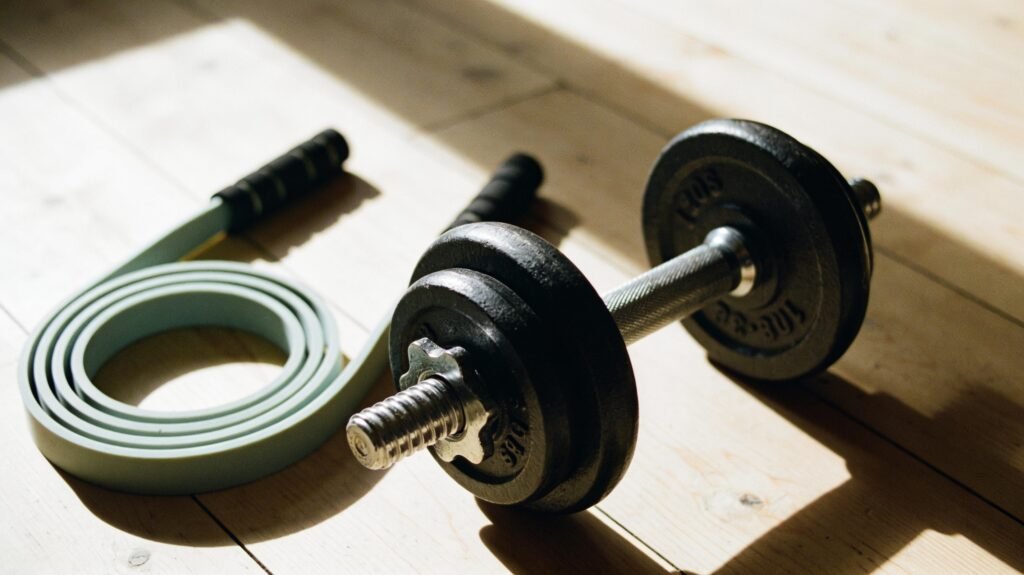
If your dumbbells or bands feel too easy, you can still progress at home with light weights. Muscles respond to challenge, not to the number on the plate, and there are several ways to raise that challenge without buying new equipment. This guide gives you seven practical methods, in a sensible order, so you can keep getting stronger with what you already own.
Strength gains come from gradually asking your body to do slightly more than it is used to. Weight is only one way to do that. Tempo, volume, rest, exercise choice and effort all count too, and beginners often find that changing just one of them makes a familiar workout feel hard again.

1. Slow Down the Lowering Phase
The easiest upgrade costs nothing. Instead of lowering a weight in one second, take three to four seconds on the way down. This is called a slow eccentric, and it makes the same dumbbell feel noticeably heavier because your muscles spend more time under tension.
Try it on squats, push-ups, rows and curls. Count silently, keep the movement smooth, and avoid bouncing out of the bottom position. If a set of 10 normally feels easy, a slow set of 10 often does not.
- Lower for three to four seconds, lift at a normal pace.
- Keep the same weight for two to three weeks while you adapt.
- Stop a set if your form falls apart rather than grinding through it.
2. Add Pauses at the Hardest Point
A pause removes momentum, which is the thing that makes light weights feel easy. Hold the bottom of a squat, lunge or push-up for one to three seconds before standing or pressing back up. Hold the top of a row or lateral raise for the same time.
Pauses also teach control. Many beginners discover that they were using a quick bounce to hide a weak spot in the movement. Fixing that weak spot is real progress, even if the weight never changes. If you are building a dumbbell routine, our full-body dumbbell plan is a good place to apply pauses.
3. Add Reps and Sets Gradually
Research on resistance training suggests that lighter loads can build muscle when sets are taken close to fatigue, as long as total work is high enough. In practice, that means moving from 10 to 15 reps, then to 20 or more, and finishing each set with only a few good reps left in reserve.
Add volume slowly. A reasonable pattern is to add one or two reps per set each week, then add a set once you hit your rep target on every set. Avoid jumping from two sets to five overnight, because your joints and tendons adapt more slowly than your motivation does.
- Week 1: 3 sets of 12.
- Week 2: 3 sets of 14 to 15.
- Week 3: 3 sets of 16 to 18.
- Week 4: add a fourth set, or move to a harder variation.
4. Shorten Your Rest Periods
If you usually rest two minutes between sets, try 45 to 60 seconds. Shorter rests leave you less recovered for the next set, so the same weight feels harder. This works best for upper-body moves and for lighter lower-body exercises.
You can also pair exercises back to back. Doing a row followed immediately by a push-up, for example, gives each muscle group a partial rest while keeping the session efficient. Keep an eye on form when you are tired, and lengthen the rest again if technique slips.
5. Switch to Harder Variations
When a weight is too light, change the exercise rather than just the load. Bodyweight and single-limb versions can be far more demanding than they look.
- Squats: move to split squats, rear-foot-elevated split squats, or step-ups.
- Hip hinges: try single-leg Romanian deadlifts with your dumbbell.
- Push-ups: elevate your feet or slow the tempo, or try a narrower hand position.
- Rows: use one arm at a time and pause at the top.
Unilateral work challenges balance and each side separately, so a modest dumbbell can feel surprisingly heavy. Beginners following a structured routine, such as our beginner strength program at home, can swap these variations in as they progress.
6. Change Leverage and Range of Motion
Small changes in body position alter how hard an exercise feels. Holding a dumbbell further from your body, extending your arms overhead or increasing the distance your body travels all raise the demand without adding weight.
- Deficit movements: stand on a low step during lunges or deadlifts for extra range.
- Longer levers: hold a goblet squat at arm’s length briefly, or do lateral raises with straight arms.
- Add a pulse: finish a set with five small partial reps at the hardest point.
Use these techniques carefully, and stop if you feel sharp or joint pain. Pain is a signal to ease off, and if it persists, speak with a doctor or physiotherapist.
7. Track Progress and Support Recovery
You cannot progress what you do not measure. Write down the exercise, weight, reps, tempo and how hard each set felt. A simple notebook works. When you can see that you did 14 reps last week and 16 this week, small wins become easier to spot and keep you motivated. Our guide on how to build a workout habit that sticks covers simple tracking ideas.
Recovery matters just as much. Muscles adapt between sessions, not during them, so rest days, sleep and enough food all affect how quickly you improve. Read why rest days matter and our tips on sleep habits for fitness. Eating enough protein also supports muscle repair, and you can find ideas in our list of high protein foods.
For general guidance on how much strength work adults should aim for, see the NHS physical activity guidelines and the Mayo Clinic strength training overview.
A Sample Four-Week Progression
Here is how you might combine these methods without changing everything at once. Train two to three times per week, with a rest day between sessions.
- Weeks 1 to 2: keep your usual weight, add a three-second lowering phase.
- Week 3: add pauses and increase reps within your range.
- Week 4: shorten rest by 15 seconds and swap one exercise for a harder variation.
After four weeks, review your notes. If the work still feels easy, move to the next variation or add a set. If you feel run down, take an easier week. Progress is not a straight line, and a lighter week is part of the process.
Common Mistakes to Avoid
Most people who stall at home make the same few errors, and they are easy to fix once you spot them. The first is changing everything at once. If you slow the tempo, cut rest, add sets and swap exercises in the same week, you will not know which change helped, and you may simply feel exhausted. Change one variable at a time and give it a couple of weeks.
The second mistake is rushing reps. A fast, bouncy set of 20 curls usually uses momentum rather than muscle, so it feels easy but delivers little. Slow down, keep your elbows still and squeeze at the top. The third is ignoring effort. A set that stops with ten reps left in the tank is rarely challenging, no matter how many sets you do. Aim to finish most sets feeling that you could manage perhaps two to four more good reps, not ten.
Finally, do not skip your warm-up. Five minutes of easy movement, such as arm circles, bodyweight squats and hip hinges, prepares your joints for the extra time under tension that these methods create. If something hurts rather than burns, stop and reassess your form.
Frequently Asked Questions
Can you build muscle with light weights at home?
Yes, for most beginners. Studies suggest that lighter loads can build muscle if you take sets close to fatigue and accumulate enough total work. Using slower tempos, more reps and harder variations helps you reach that point without buying heavier equipment. Results vary between individuals, so track your own progress.
How do I know when it is time to buy heavier weights?
Consider heavier weights when you can complete every set at the top of your rep range, around 20 or more reps, with slow tempo and still feel you could do many more. Try harder variations first. If those no longer challenge you, adjustable dumbbells or bands are a sensible next step.
How often should I increase the difficulty?
A gradual approach works well for beginners. Try changing one thing every one to two weeks, such as adding reps, slowing tempo or shortening rest. Changing too many variables together makes it hard to tell what is working and can raise your risk of soreness or overuse problems.
Is it safe to train close to failure at home?
Training close to fatigue can be fine when you use good form and stop before technique breaks down. Beginners should leave a few reps in reserve, avoid heavy, unsupported moves, and skip failure on balance-challenging exercises. If you have a health condition or injury, check with a healthcare professional before increasing intensity.
Final Thoughts
Light weights are not a dead end. By slowing tempo, adding pauses, increasing volume, shortening rest, choosing harder variations, changing leverage and tracking your work, you can keep making progress at home for months. Start with one or two methods this week and build from there. This article is general information and not medical advice.