No treadmill, no bike, no membership, no problem. Your own body weight is the only cardio machine you actually need, and the science backs this up completely. The American Heart Association’s target of 150 minutes of moderate activity per week says nothing about owning equipment or paying for a gym. This at-home cardio workout with no equipment gives you twenty moves, a ready-to-follow routine, low-impact swaps so your downstairs neighbors stay friendly, and a full weekly plan.
Whether you have a spare bedroom, a garage, or just a patch of floor beside the couch, you can raise your heart rate, torch calories, build real stamina, and improve your heart health in about twenty minutes.
Why no-equipment cardio actually works
Cardio, at its core, simply means moving large muscle groups rhythmically for long enough to challenge your heart and lungs. Sprinting on the spot does that every bit as effectively as a stationary machine. In fact, bodyweight cardio recruits your core and stabilizing muscles constantly, because you have to control your own body through space, so you often get more true full-body work than sitting strapped to a bike.
There is also the consistency factor. The best exercise program is the one you actually do, and a workout that requires zero setup, zero commute, and zero equipment is one you are far more likely to repeat on a busy day.
Warm up first (do not skip this)
Two to three minutes of easy movement primes your muscles and joints and sharply reduces injury risk. March in place with big arm swings, roll your shoulders, add gentle leg swings and torso twists, then a handful of slow bodyweight squats to raise your body temperature before you work hard.
20 no-equipment cardio moves
Higher-impact (maximum intensity)
Jumping jacks, high knees, butt kicks, burpees, mountain climbers, squat jumps, skater hops, star jumps, tuck jumps, and jump lunges. These spike your heart rate fastest and burn the most calories per minute.
Low-impact (joint- and apartment-friendly)
Marching in place with big arm swings, standing knee-to-elbow, fast toe taps, lateral step-touch, shadow boxing, a slow-motion squat-to-reach, speed-walking around the room, standing oblique crunches, a low-impact grapevine side step, and controlled inchworm walkouts. Every jumping move has a low-impact twin, so nothing gets thumped downstairs.
The 20-minute at-home cardio routine
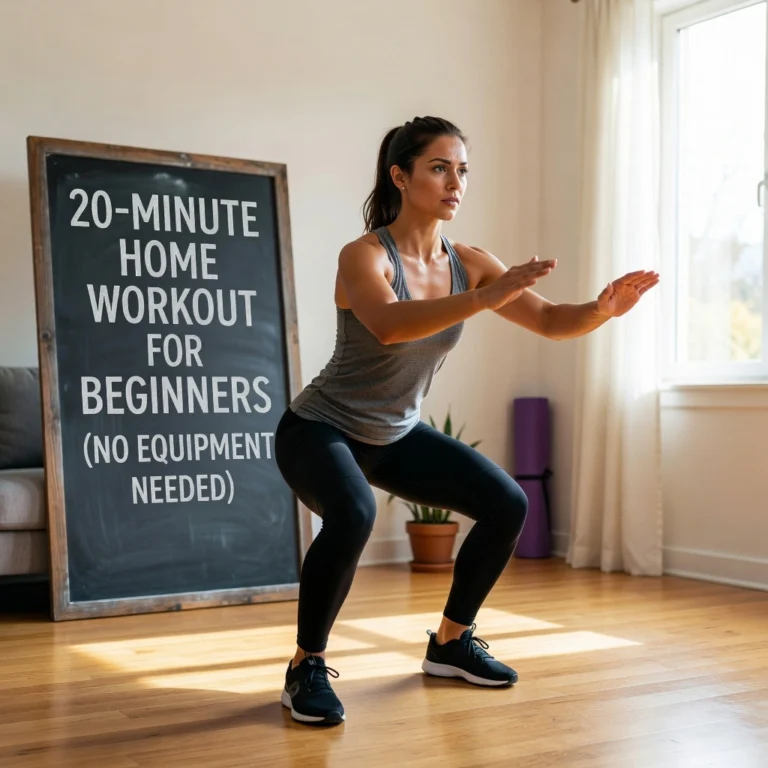
Do each move for 40 seconds, then rest 20 seconds, and repeat the whole circuit twice. Warm up first. Pick the high-impact or low-impact version of each move depending on your fitness and your floor.
- Jumping jacks (or step-touch)
- High knees (or marching high knees)
- Squat jumps (or slow squats)
- Mountain climbers (or standing knee drive)
- Skater hops (or lateral step-touch)
- Shadow boxing
- Burpees (or squat-to-reach)
Finish with two minutes of slow marching, then stretch your calves, quads, hips, and shoulders. All in, that is roughly 20 minutes and burns an estimated 150 to 300 calories depending on intensity and body size.
Want a HIIT version? Try Tabata
Pick four moves, and for each go all-out for 20 seconds, then rest 10 seconds, repeating each move eight times before moving on. This classic Tabata structure improves cardiovascular fitness efficiently, and four minutes per move done properly will leave you genuinely breathless.
How to make it harder or easier
To progress, add a third round, shorten rest to 15 seconds, or choose the high-impact option for every move. To dial it back, stick to the low-impact column, extend rests to 30 seconds, and drop to a single circuit. The right intensity leaves you breathing hard but still able to speak in short sentences.
A simple weekly cardio plan
Monday: 20-minute mixed-impact circuit. Tuesday: bodyweight strength. Wednesday: 20-minute low-impact cardio or brisk walk. Thursday: rest or gentle stretching. Friday: Tabata HIIT. Saturday: fun cardio like a dance workout or long walk. Sunday: full rest. Give yourself at least one full rest day, because recovery is when fitness is actually built.
Common mistakes to avoid
Skipping the warm-up and cool-down, only ever going flat-out high-impact, holding your breath during hard intervals, comparing your day-one self to someone’s highlight reel, and expecting cardio alone to transform your body while ignoring what is on your plate.
Will it burn fat?
Three to five sessions a week steadily improves your endurance, mood, sleep, and heart health. For fat loss specifically, the honest part is that the kitchen matters more than the living room. You cannot out-jump a consistently poor diet, because fat loss ultimately requires a calorie deficit. Use these sessions to feel strong and energized, and let sensible nutrition do the heavy lifting on the scale.
Frequently asked questions
Can you get a good cardio workout at home without equipment?
Absolutely. Bodyweight moves like high knees, jumping jacks, and burpees raise your heart rate as effectively as machines while adding core work. Three to five 20-minute sessions a week meet standard activity guidelines with zero gear.
What is the best no-equipment cardio for small apartments?
Stick with low-impact moves: marching with big arm swings, step-touch, standing knee drives, shadow boxing, and fast toe taps. They keep your heart rate up without jumping, so they are quiet and joint-friendly.
How long should an at-home cardio workout be?
Twenty minutes of interval cardio is enough for a strong effect. Add a third round or HIIT finisher for more. Aim for about 150 minutes of moderate activity per week.
Is no-equipment cardio enough to lose weight?
It helps by burning calories and improving fitness, but weight loss depends most on a consistent calorie deficit through diet. Cardio and nutrition work best together.