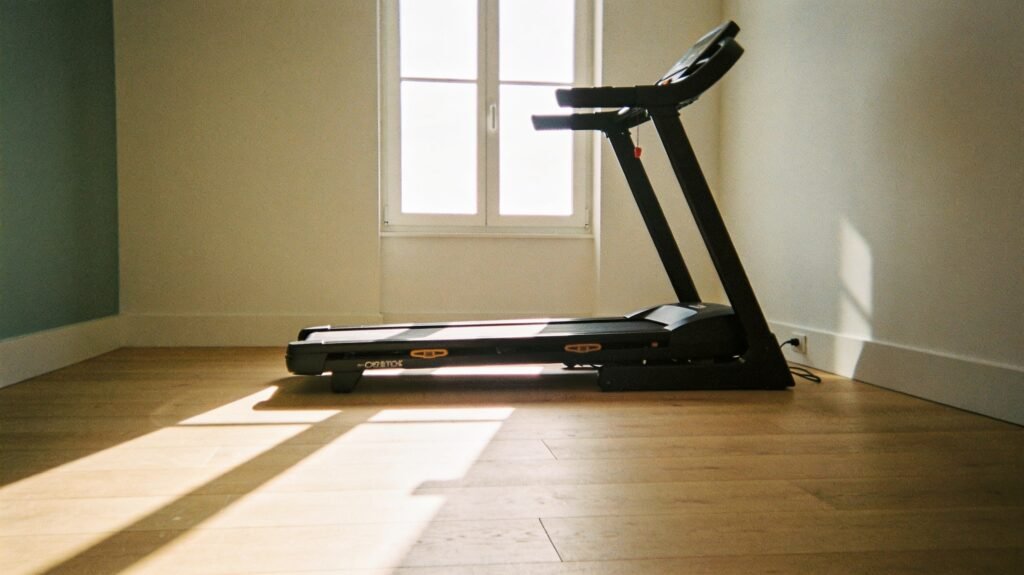
Looking for treadmill workouts for fat loss that are not just plodding along at the same speed for 40 minutes? These five beginner-friendly sessions use incline, intervals and steady effort to keep things interesting while building fitness. Each one takes 20 to 35 minutes and needs nothing but a treadmill.
A quick honest note: no workout burns fat on its own. Body-fat change depends on your overall eating, sleep, stress and activity across weeks and months. What a good treadmill plan does is give you a repeatable way to move more, improve your cardio fitness and stay consistent.

Before you step on the belt
A few basics make every workout below safer and more effective.
- Warm up for 5 minutes. Walk at an easy pace and gradually raise the speed until you are breathing a little harder.
- Use the effort scale. Rate effort from 1 to 10. Easy is 3 to 4, moderate is 5 to 6, hard is 7 to 8. You should be able to talk in short sentences at moderate effort.
- Hold the rails lightly or not at all. Leaning on them lowers the work and can affect your posture. Use them only for balance.
- Clip the safety key. Attach the safety clip to your clothing every time and know where the stop button is.
- Check in if needed. If you have a heart, lung or joint condition, take medication that affects exercise, or have been inactive for a long time, speak with a healthcare professional first.
If you are new to running specifically, read our guide on how to start running as a beginner without getting injured before attempting the run-based sessions. Walking versions work perfectly well for all five workouts.
1. Incline walk for beginners
Incline walking raises your heart rate without the impact of running, which makes it a favourite for beginners. It also works your glutes and calves more than flat walking.
- 5 minutes: warm-up walk at 0 to 1 percent incline.
- 20 minutes: walk briskly at a comfortable speed, 3 to 6 percent incline.
- 5 minutes: cool down at 0 percent and a slower speed.
Start with an incline that lets you keep good posture. If your lower back feels tight or you are gripping the rails, lower it. Speed matters less than staying steady and upright.
2. Easy run-walk intervals
Alternating short jogs with walking recoveries is a gentle way to build running fitness. It also lets you accumulate more higher-effort minutes than you could in one continuous run.
- 5 minutes: warm-up walk.
- Jog for 1 minute at a pace that feels like 6 out of 10.
- Walk for 2 minutes to recover.
- Repeat the jog-walk cycle 6 to 8 times.
- 5 minutes: cool-down walk.
When it feels comfortable after a couple of weeks, shorten the walking to 90 seconds or lengthen the jog to 90 seconds. Change only one thing at a time.
3. Zone 2 steady cardio
Zone 2 describes easy to moderate aerobic effort, roughly a pace where you can hold a conversation. It is not flashy, but it builds an aerobic base and is easy to recover from, so you can do it more often than hard sessions.
- 5 minutes: warm-up.
- 25 to 35 minutes: steady walk or light jog at an effort of about 4 to 5 out of 10.
- 5 minutes: cool-down.
If you track heart rate, many people find this zone sits somewhere around 60 to 70 percent of their estimated maximum, though individual ranges vary. The talk test is a simpler guide. Use music or a podcast to make the time pass.
4. Hill climber intervals
This workout alternates incline climbs with flat recoveries, so it feels like walking up a series of hills.
- 5 minutes: warm-up.
- Climb for 2 minutes at 6 to 8 percent incline at a brisk walking pace.
- Recover for 2 minutes at 0 to 1 percent incline at an easy pace.
- Repeat 5 to 6 times.
- 5 minutes: cool-down.
Keep your steps full and your torso tall as you climb. If the incline feels too steep, drop it by 1 or 2 percent. Hill work is demanding on calves and Achilles tendons, so ease in gradually and stretch afterwards.
5. Pyramid speed intervals
Pyramids vary the length of the hard efforts, which keeps your mind busy. Choose a pace you could hold for one minute but not five, and keep it controlled.
- 5 minutes: warm-up.
- Work for 30 seconds, recover 60 seconds.
- Work for 60 seconds, recover 90 seconds.
- Work for 90 seconds, recover 2 minutes.
- Work for 60 seconds, recover 90 seconds.
- Work for 30 seconds, recover 60 seconds.
- 5 minutes: cool-down.
Do this session only once per week to start, and only after you have done the other workouts comfortably for at least two to three weeks. Interval work is the most tiring of the five, so give it a rest day on either side.
How to fit these into your week
A simple beginner week could look like this:
- Monday: Workout 1, incline walk.
- Wednesday: Workout 2 or 4, an interval session.
- Friday: Workout 3, Zone 2 steady cardio.
- Weekend: an optional easy walk, or Workout 5 once you are confident.
Aim for two to four treadmill sessions per week, with strength training on separate days. Lifting weights helps maintain muscle while you are active, which is why we often recommend combining both, as explained in strength training for weight loss and why lifting burns fat. For ideas away from the treadmill, see the best cardio workouts for weight loss at home.
Daily movement counts too. Our article on how many steps per day for weight loss explains how a walk on a rest day adds up. And do not skip recovery: rest days are essential for progress.
For general activity targets, the CDC adult physical activity guidelines suggest about 150 minutes of moderate-intensity activity weekly, which these sessions can help you work towards.
Treadmill mistakes to avoid
- Starting too fast. Beginners often pick a speed they cannot sustain. Choose a pace you can repeat.
- Holding the handrails. This reduces the effort and can pull your posture forward.
- Staring at the belt. Look ahead at the console or a fixed point to keep your head and shoulders up.
- Using high incline and speed together too soon. Raise one variable at a time.
- Doing hard sessions back to back. Space them by at least 48 hours.
- Relying only on calorie counters. Treadmill estimates are rough. Use them as a ballpark, not a target.
How to track progress and keep it fun
Progress on the treadmill is easy to measure if you note a few simple things after each session: the workout you did, your average speed or incline, and how hard it felt on the 1 to 10 scale. Over four to six weeks you should see the same effort feel easier, or the same speed feel more comfortable. That is a real sign your fitness is improving, even if the scale barely moves.
Boredom is the main reason people quit treadmill cardio, so build in variety. Rotate the five workouts, watch a series you only allow yourself on the treadmill, or follow a podcast. Some people like to set a small weekly goal, such as completing three sessions, instead of chasing a speed. Others walk outdoors once a week for a change of scenery. Choose whatever keeps you coming back, because the best plan is the one you actually repeat.
Finally, listen to your body. Mild muscle fatigue is normal when you start, but sharp pain, dizziness or unusual breathlessness are signals to stop and speak with a healthcare professional. Wear supportive, well-fitting shoes and replace them when they feel flat, as worn-out footwear can make joints feel more stressed than they need to.
Frequently asked questions
How long should I use a treadmill for fat loss?
Most beginners do well with 20 to 35 minutes, two to four times per week. Consistency matters more than length. Fat loss also depends on your eating, sleep and overall activity, so treat the treadmill as one part of a bigger routine rather than the whole plan.
Is incline walking better than running?
Neither is universally better. Incline walking is lower impact and works well for beginners, while running burns energy faster per minute but is harder on joints and recovery. Choose the option you can do consistently and comfortably, and mix both over time.
How often should I do treadmill intervals?
Once or twice a week is plenty for most beginners. Intervals are demanding, so leave at least a day or two between hard sessions. Fill the other days with easy walking, Zone 2 sessions or rest, and build volume gradually.
What speed should a beginner use on the treadmill?
There is no single right speed. Use the talk test: at an easy pace you should be able to hold a conversation. Many beginners walk somewhere between 3 and 4 miles per hour, but your height, fitness and comfort matter more than a number.
Final thoughts
These five treadmill workouts for fat loss give you variety, from gentle incline walks to hill and pyramid intervals. Start with the easier sessions, add one change at a time and keep your week balanced with strength work and rest. Small, repeatable sessions are what build fitness over time.
This article is general information and not medical advice. If you have a health condition, an injury or take medication, speak with a qualified healthcare professional before starting a new exercise programme.