


Most gym-goers spend years chasing aesthetics while neglecting the movement patterns that actually govern how well they function in real life. Functional strength training builds the kind of strength that transfers directly to everyday activities — carrying groceries, climbing stairs, lifting children, getting up from the floor, and moving through life without pain or limitation. This guide covers the 10 essential movement patterns that every adult should develop, and exactly how to build them.
What Is Functional Strength Training?
Functional training is movement-based rather than muscle-based. Traditional bodybuilding isolates individual muscles (bicep curls, leg extensions, chest flyes). Functional training trains movement patterns that engage multiple joints and muscle groups simultaneously — mirroring the complex, coordinated movements humans need for daily life and sport.
The research supports this approach strongly. A 2019 study in the Journal of Strength and Conditioning Research found that functional training produced superior improvements in balance, coordination, and activities of daily living compared to traditional machine-based training, even when the total training volume was matched.
❓ Quick Knowledge Check
What is the PRIMARY difference between functional training and traditional bodybuilding?
The 10 Fundamental Movement Patterns
1. The Squat Pattern
Sitting down and standing up — you perform a squat pattern dozens of times daily without thinking about it. Developing strength in this pattern protects your knees, hips, and spine, and builds the powerful quadriceps and glutes that support nearly every athletic movement. Key exercises: bodyweight squat, goblet squat, barbell back squat, front squat. Start with a bodyweight squat holding a door frame for balance if needed.
2. The Hip Hinge Pattern
Picking something up from the floor is a hip hinge. This is perhaps the most injury-preventive movement you can train — lower back injuries are overwhelmingly caused by poor hip hinge mechanics. The hip hinge loads the hamstrings and glutes through their full range, building powerful posterior chain strength. Key exercises: Romanian deadlift, conventional deadlift, kettlebell swing, good morning.
3. The Vertical Push Pattern
Pushing something overhead — placing items on a high shelf, carrying luggage into an overhead bin, or pressing a child above your head. This pattern builds shoulder stability, core integration, and overhead mobility. Key exercises: overhead press, Arnold press, push press, landmine press.
4. The Horizontal Push Pattern
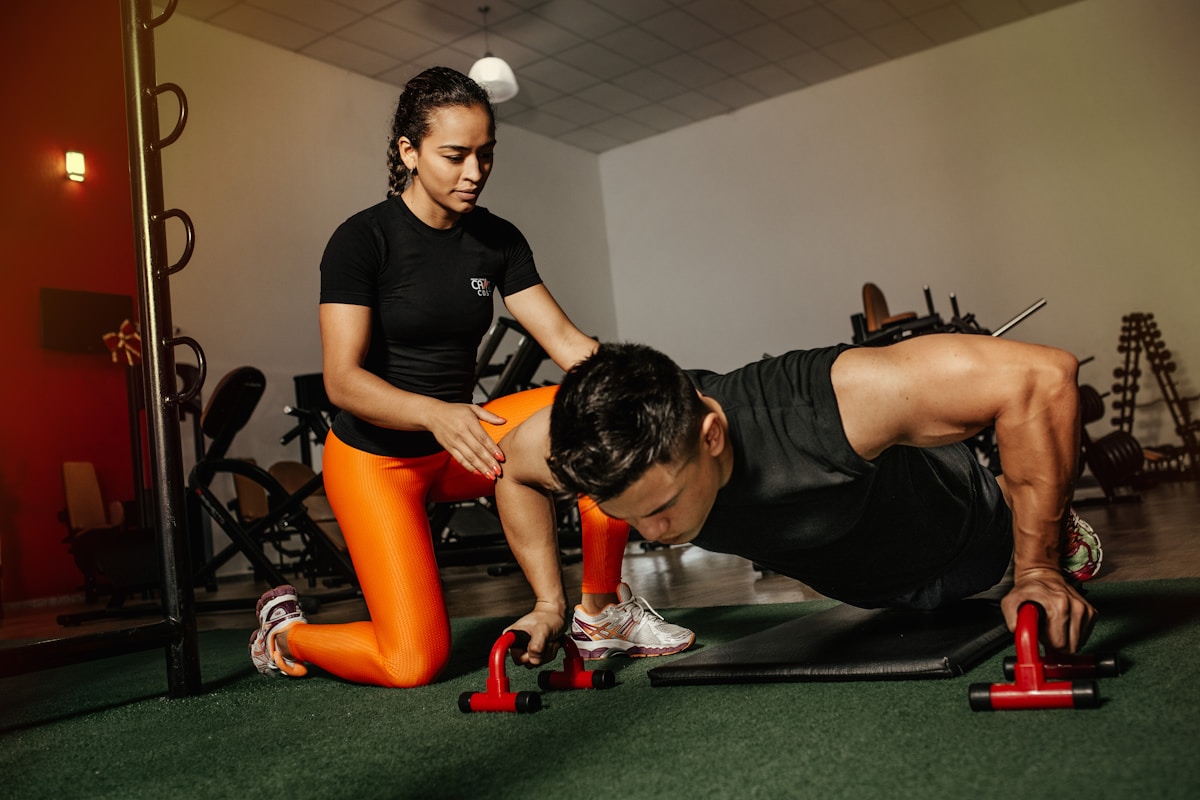
Pushing horizontally — opening a heavy door, pushing a shopping trolley, or performing CPR — requires strong chest, shoulder, and tricep coordination. Key exercises: push-up (and all progressions), bench press, dumbbell press, cable chest press.
5. The Vertical Pull Pattern
Pulling yourself up — climbing, pulling yourself out of a pool, or simply reaching something above you requires vertical pulling strength. This pattern is the primary builder of the latissimus dorsi, the largest muscle in the back, and develops the shoulder stability essential for injury prevention. Key exercises: pull-up, chin-up, lat pulldown, assisted pull-up machine.
6. The Horizontal Pull Pattern
Opening a car door, rowing a boat, pulling a drawer open — horizontal pulling is foundational for upper back strength and posture. Most people are dramatically weaker in pulling than pushing, creating imbalances that cause shoulder and neck pain. Key exercises: dumbbell row, barbell row, cable row, TRX row, resistance band row.
7. The Lunge/Single-Leg Pattern
Climbing stairs, walking on uneven ground, and recovering from a stumble all require single-leg strength and stability. Training unilateral (one-sided) lower body movements also reveals and corrects strength imbalances between limbs. Key exercises: forward lunge, reverse lunge, split squat, Bulgarian split squat, step-up.
8. The Anti-Rotation Core Pattern
True core strength is not about crunching — it is about resisting unwanted movement, particularly rotation and lateral flexion. The core’s primary role is to stabilise the spine while the limbs generate force, like a solid platform from which your arms and legs work. Key exercises: Pallof press, dead bug, plank variations, bird-dog, suitcase carry.
9. The Rotation Pattern
Twisting to reverse into a parking space, swinging a bat or racket, or even turning to talk to someone beside you in the car — rotational strength is essential for athletic performance and spinal health. Key exercises: cable woodchop, medicine ball rotational throw, Pallof press with rotation, landmine rotation.
10. The Loaded Carry Pattern
Carrying groceries, luggage, a child, or anything else while walking — the loaded carry might be the most underappreciated exercise pattern. It builds total-body stability, grip strength, core endurance, and cardiovascular fitness simultaneously. Key exercises: farmer’s carry (both hands), suitcase carry (one hand), overhead carry, front rack carry.
⚙ Your 3-Day Functional Strength Programme
Day A: Goblet squat 3×8 | Push-up 3×10 | Dumbbell row 3×10 | Dead bug 3×8 each side | Farmer carry 3x20m
Day B: Romanian deadlift 3×10 | Overhead press 3×8 | Lat pulldown 3×10 | Bird-dog 3×8 each | Split squat 3×8 each
Day C: Goblet squat 3×10 | Push-up 3×12 | Cable row 3×10 | Pallof press 3×10 | Suitcase carry 3x20m each side
Rest 60–90 seconds between sets. Increase weight when you can complete all reps with excellent form.
How to Progress Your Functional Training
The principle of progressive overload applies to functional training exactly as it does to conventional strength training. Your body only adapts when it is consistently challenged beyond its current capacity. Progress through these stages:
Stage 1 — Master the Movement: Use the lightest possible load (bodyweight or very light weight) and focus entirely on movement quality. A well-executed bodyweight squat trains the nervous system as effectively as a heavy loaded squat for beginners.
Stage 2 — Add Load: Once movement quality is consistent, add resistance progressively. Small increments of 2.5–5kg produce continuous adaptation without overwhelming recovery capacity.
Stage 3 — Increase Complexity: Add elements like instability (single-leg variations), asymmetric loading (one dumbbell instead of two), or combined movements (squat to press) to further challenge the nervous system and transfer to real-world demands.
▶ WATCH: Functional Strength Training for Beginners
Follow-along functional movement tutorials for all fitness levels.
🔍 Watch on YouTubeWhy Functional Training Reduces Injury Risk
The majority of injuries in everyday life and sport occur during complex, multi-joint movements — not during simple isolated movements. When you train the movement patterns that life demands, you build neuromuscular coordination, proprioception (body position sense), and strength through the specific ranges of motion where you are most vulnerable.
Lower back pain, the most common musculoskeletal complaint worldwide, is largely a hip hinge and anti-rotation core strength problem. Knee pain is frequently a squat pattern and hip abductor weakness problem. Shoulder pain often relates to pushing/pulling imbalances. Functional training addresses these root causes rather than treating symptoms.
🚀 Your Starting Point: Assess yourself on each of the 10 patterns with bodyweight only. Which ones feel weak, limited, or uncomfortable? Those are your priorities. Start your functional training programme by dedicating extra attention to your two or three weakest patterns. In 8 weeks, reassess — the improvements in how you move and feel in daily life will be immediately noticeable.
👉 Source: ACSM: Functional Movement and Strength Training Guidelines